
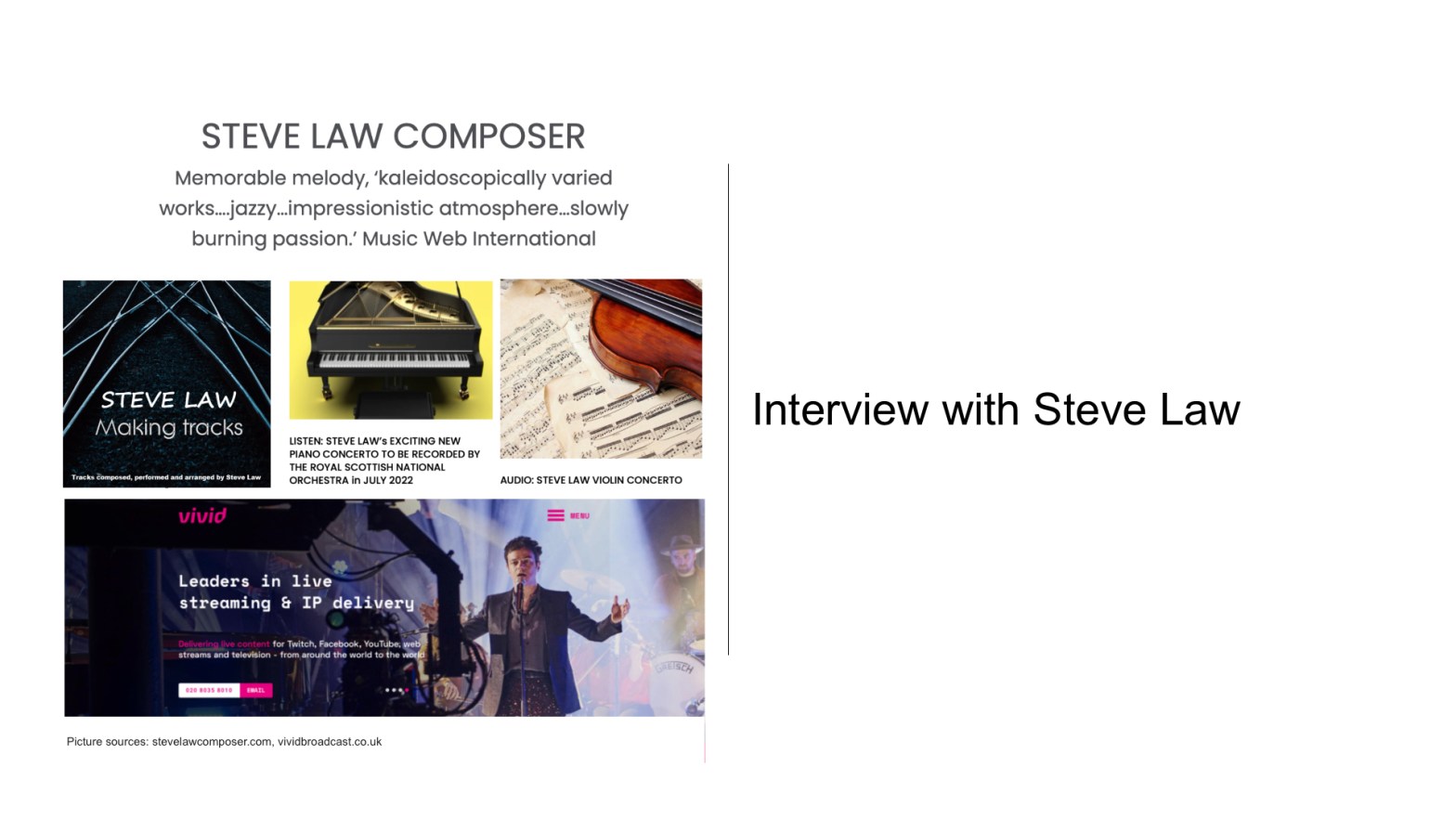
Steve is a composer with influences from classical music, jazz and pop. In our time together we shared our perspectives on the development of orchestral music today. Scattered throughout the interview are also insights into Steve’s compositional process. Are we abandoning the complexity, sophistication and beauty for chords I – IV – V? Or are there aspects in everything that we can celebrate?
KAI:
Thank you for taking your time to talk to me today, Steve. I wanted to ask you about your journey with music, composition, and orchestral life more generally. What do you think is the place for orchestral music in our contemporary musical landscape?
STEVE:
I suppose orchestral music today doesn’t perhaps have the sort of burning sense of importance that it used to have in the past where music had a sense of direction and people were discovering new things all the time. If you were waiting for Beethoven’s latest symphony to be performed or the Rite of Spring being performed or any of these sorts of big events. I find it hard to see any sort of clear direction and music anymore.
KAI:
Interesting to hear. In what way do you see music developing now?
STEVE:
I suppose we are mixing things that have gone before to try and make new sort of combinations of things. On the plus side, I think that anything goes now as far as music is concerned. It’s also easier to create music and get it performed. There are far more avenues to have your music heard if you’ve got the persistence and the talent to make that happen. As far as I can see the last big movement in classical music was minimalism. That seems to have had quite a big effect on contemporary music. The rhythm, the melody and the sense of joy in that music seems to have filtered through to current composers. Also this idea of coming back to more simplicity, more approachable music, let’s say, for the average person. That certainly has influenced even composers who write complicated music. From my perspective, I would say jazz went so far and we discovered so much. Pop music, I suppose, has been the most innovative in terms of form, but I mean I see that not really going anywhere musically. It’s become so formulaic now. Everything has four bar repeating patterns rather than experimentation and individuality. For me, the influence of pop and jazz music is impossible to escape. Why would you escape it? We can’t help but be influenced by the music we grew up with and music is always changing, isn’t it?
What would you sort of say to orchestral music now yourself?
KAI:
I find it very interesting to see that in a lot of audiences we are missing younger people. I have been wondering about how we can reach younger people with the orchestral sound. They might listen to pop songs on the radio and that is great, but I do think an orchestra has so much to give. On the other hand, I find that young people do love films and in many of them the soundtracks are saturated with orchestral music. They might not go to a classical concert, but they enjoy film music. Is it the style of music? Is it the fact that there’s other media involved, such as film?
STEVE:
Film music is something that people do relate to very quickly, don’t they? John Williams scores for example. They incredible scores, really… and that’s still being played today in concerts in the Royal Albert Hall with the film being shown – it hasn’t lost its magic. I hope that is a great way of getting young people interested. That’s how I heard the orchestra for the first time and it opened up a whole new world for me because those people were influenced by all these other composers, whether it’s Sibelius, Prokofiev or whoever it was. Film music is a gateway into classical music, isn’t it?
KAI:
This point is probably a good moment for me to ask how you became a composer?
STEVE:
When I was young my father played the piano at home. I always liked the piano. I copied the teachers at school playing the hymns in the assembly, so I learned by ear. When I was about twelve years old my mother bought me an LP of Scott Joplin’s piano rags. From that moment on I was interested in that. Then I saw a BBC documentary on George Gershwin and became slightly obsessed with that. I started to try and write piano rags and Gershwin type pieces. I then heard Rachmaninoff and Prokofiev and obviously Beethoven and others. It actually came to me a little bit late. I was writing music really from the time I first saw notated music in the form of Ragtime. Through Gershwin and Rachmaninoff the world just began to open up in quite an incredible way. It blew my mind hearing some of this music for the first time.
I grew up listening to pop music, which I loved. The music from the late 70s and 80s had a big influence on the sounds that I hear. I’ve just been watching a box set of The Rockford Files (1974-1980) and you know, you hear all these chords and things, and oh my goodness, I put those in my pieces! In the subconscious they have gone in there somewhere. I think there was a sort of hangover of jazz harmony into 70s and 80s music even for disco and some of the electronic music. Now everything has so much functional harmony and I find that very dull to listen to. I suppose I’ve got used to a very rich sounding palette of harmonies, but of course not everyone listens to music that way. I’ve spent my life listening to music intently. Not everyone hears music in the same way and not everyone has the time to listen to pieces of music over and over and over. You don’t find too many good listeners out there anymore. People often just listen to music in the background – everyone enjoys music in different ways. But then there is such a huge variety of music as well and that’s what makes it so great.
How about yourself? How did you how did you get into composition?
KAI:
I always played in orchestras. First of all cello in youth orchestras, later percussion. Particularly as a percussionist, sometimes I found myself thinking, “I understand what I am supposed to play, but that’s not actually what I would like to play.” There was a real sense of “I don’t think the composer really understood what a percussionist would want to do here…”, which then made me think, “I wonder if I could write something.” I wanted to write music that on the one hand side the audience would enjoy, but on the other hand side every musician would enjoy too. It is common for certain instruments to play melodies, such as the first violins and others, but I wondered what would happen if every instrument in the orchestra had a moment of shine… This wouldn’t be the case all the time of course, but I enjoyed thinking about foreground and background and giving everyone a space in that. I had lessons on several instruments and think that has given me a certain sensitivity to the music. Understanding the players who will hold your score in their hands is so important. I think for me it has also been of interest of going beyond the simpler types of music to thinking about different lines, interactions between instruments, vertical and horizontal movement and colours… I’m exploring all of this at the moment, so conversations like this are so helpful and inspiring.
STEVE:
This is the thing. The more you explore, the more you don’t want to be confined to just doing this or that. It’s quite incredible with jazz harmony, considering just how far that got. Think of someone like Bill Evans, for example. Look at the complexity, the sophistication and the beauty of what he did. It seems that this whole world was just there to be discovered: diminished scales, diminished chords… all these things and how they work. I mean it’s mind blowing! It’s like mathematics. It was there to be discovered and somebody found it. It then gradually evolved to the state it is at now. It seems a terrible shame to turn our back on all that discovery and go back to doing chords one, four, and five again. To me it seems a bit crazy to simply forget about these people; that’s terrible, really.
KAI:
Do you think your interest in harmony also comes from being a pianist?
STEVE:
Definitely! Always tinkering… Composing is a searching process, isn’t it? You’re constantly trying to find things. I think Prokofiev might have said that. I’m perhaps not the most harmonically adventurous composer in the world, but I do have an idea of the sounds I like, and I suppose that’s all we can do. I do admire composers who have the courage to invent more, to experiment and try to stick their neck out. But then do you end up with a situation where everything is so discordant that the discords don’t really work? What’s the point of discord then? There’s no right or wrong about it. I do like some modern music and maybe it’s just not for me. Also, when I write music it has to be life affirming, positive and uplifting. I don’t want to be dwelling upon negative feelings in my music and be self-indulgent in that way. That is not to say for anybody who tries to bring out these profound, dark sorts of feelings that that’s a bad thing at all. It’s just for me personally it’s the thing that picks me up in life.
There are so many composers out there but the one thing I do have, I think, is the ability to write a tune. If you’re going to write music, try and make it as memorable as possible. It doesn’t have to be a tune that makes it memorable, but it has to be memorable in some way. I’d rather write less good music than reams and reams of bad music, but at the same time you have to keep at it and just getting the practice of doing it every day in order to get better. Sometimes we sit around waiting for inspiration and it doesn’t come… You have to search for it, then it will come. It’s hard to find the time though. I teach the piano to pay the bills. I’d love to spend all my time doing music, but it’s difficult to justify spending vast amounts of time on composition. Chopin had to teach, like practically everyone else. For me doing this concerto recently… it’s really been tough mentally. Doing it all by myself and grappling with software as well… Also, there are so many composers, conductors and musicians who have found it very difficult to have a stable private life relationally, you know, it’s not easy.
KAI:
I’ve been thinking about that too, that success in life isn’t just success in your compositions, but being healthy in all areas of life. Sometimes that can means spending less time on, say music, and more time investing in your relationships.
STEVE:
… because obviously there is more to life than music.
KAI:
I can’t believe we’re saying this (laughing)!
STEVE:
It’s a part of life, isn’t it? – A great part of life! But that’s the arts in general. Imagine if you didn’t have art… We need it to express ourselves and feel human; not to feel alone and all these other things. And we’re very lucky to be living at a time where music is so accessible. When I was young, I had to go to the library to pick up a score. That wasn’t a big deal, I was happy with that. These days you just go on the internet. It’s become almost too easy. I mean I just do not understand how someone could be bored in this day and age. You’ve got all that at your fingertips. It’s incredible. We’re so spoiled. We’re so lucky.
KAI:
Maybe people are so spoiled that they don’t access what they could because it is so much…?
When you are composing, do you focus more on the music itself or do you think about who will listen to it?
STEVE:
I suppose I think of myself as writing a kind of clever popular music if you like. Hopefully it appeals to a wide audience of all ages. If I was to write video game music or something like that, I could perhaps be more specific about what I would want it to sound like. I just try to be honest and write what I feel. I think that’s all anyone can do at the end of the day. Musicians don’t tend to be very good businessmen, without being cynical, but you know, in terms of aiming for certain audiences. As far as writing is concerned, I would hope that my music connects with people immediately and is memorable. That’s all I can do. How do you approach it?
KAI:
I’m just thinking about that. I guess it’s one thing to write something inspiring but if you’re audience is not at the concert in the first place… I’m also thinking about how we can ‘bring’ music to people.
Something I found quite interesting with what you’re saying then is your love for popular music and how jazz influences your orchestral compositions. That can be a very good bridge for people, can’t it?! The popular forms being mixed with orchestral sounds… I have been thinking about links between creative practices and musical genres, whether that is pop, jazz, or collaborating with other arts.
STEVE:
There has to be some sort of cross-fertilization with what’s going on at the time. Saying that, Gershwin came up with something completely different just by being himself. He was a songwriter and he enjoyed the influence of jazz… he wasn’t a jazz player, but he did improvise and was a genius at what he did – and he did come up with something new. So, I think it’s going to be combining new things in popular music with classical music. We can’t turn our back on jazz and popular music. That’s not going to happen. It’s been discovered. But then, you know, maybe there’s also room for disregarding jazz harmony and going back to classical harmony as well. It’s the old cliché of ‘you can’t please all people all the time.’ Everyone hears music differently. That’s the problem. I never really know how people hear anything that I do. If one person likes it, that’s one more person than no people. If I can make someone happy, sharing something I’ve got that is worth something…. if it’s worth something and makes someone happy then that’s job done for me.
KAI:
Thank you, Steve. I really appreciated talking to you and hearing your perspective on music and how you recognize how your sound has been shaped over time. All the best!
To find out more about Steve, visit his website.
 Kai Vollprecht Media