
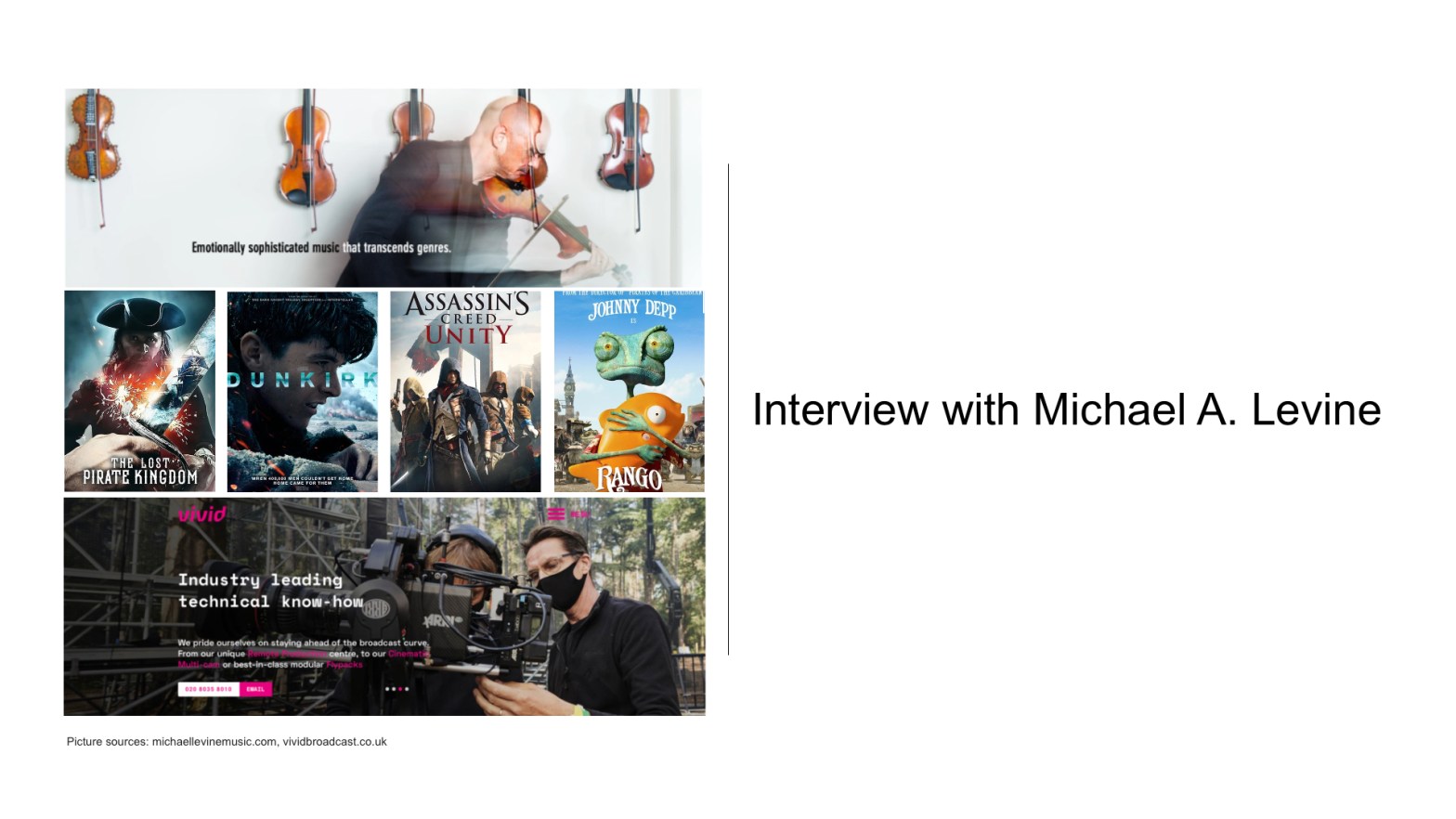
From the streets on St. Paddy’s Day to Hans Zimmer conducting one of his arrangements at the Hollywood Bowl and from advertising jingles to blockbuster hits… As composer for film and television Michael has been involved in numerous projects, such as Pirates of the Caribbean: Dead Man’s Chest, Batman: The Dark Knight, Rango, Dunkirk, The Hunger Games: Catching Fire, Assassin’s Creed: Unity, the recent Netflix hit The Lost Pirate Kingdom and many more… In our conversation we spoke about his personal journey with music and film, the changes and developments he sees in orchestral music and the power of collaboration. After 50 plus years of work he still has 100 things he wants to do!
KAI:
Hi Michael, thank you for your time. It’s great to talk to you! As an introduction, how would you describe who you are and what you do?
MICHAEL:
(Laughing)… 50 plus years of work, there’s some depth there… Look, I started out as a songwriter and as a rock and roll guy who also played the violin in orchestras. So, I’ve always been what I describe as a pathological eclecticist.
I made a living in a whole variety of ways as a youth. I was playing Irish music at St. Paddy’s Day, had an original band… and you know we thought we were going to be famous. Eventually I started writing music for advertising and discovered I really liked it and did that for many years but at a certain point I kind of got bored with the process. The business was changing and I just felt I wanted a bigger canvas. I moved out to LA to write music for films.
Through a series of ridiculous strokes of luck I ended up working with Hans Zimmer. Great education for me! To this day I continue to write music for both my own projects and occasionally for others, including for Hans when he calls me, but I have also become very interested in screenwriting. Before I thought I would be a professional musician I wanted to be a playwright and it seems that I have come full circle with that in some ways. I wrote a short film that’s been making the festival rounds and has won several awards. I’ve also written a bunch of other scripts; let’s see if it leads to anything. I am fortunately at a point in my life where I can take those kinds of risks without losing the roof over my head. Not everyone can do that. I mean certainly when I think about my 20s… I was playing music on the street because I had to.
KAI:
What fascinates you about music? What triggers your interest?
MICHAEL:
I am fascinated by how humans are this great contradiction. We are these rugged, devout individualists who desperately want to connect with each other, and music is one of those things that does both. You get to express yourself as well as connect with others at the same time. It’s a different kind of language. I mean language is a beautiful invention as well, but music, dance, the visual arts… all these things are part of what makes us human.
KAI:
How would you describe what happens when you combine visual art, music, sound, dance… that fusion of creative practices coming together?
MICHAEL:
Well, each one is communicating in a different language. I once asked Hans, “How would you define the job of a composer?” It’s one of those stupid open-ended questions. He thought for a second and said, “To think of the things that the director didn’t think of.” Yes, a good film score communicates something that can’t be communicated in any other way. Every one of those disciplines supports the other but also says something unique. That’s why you’ve got a billion names listed on the credits. Every one of those people does something important.
One of my favourite quotes on this is from the book In the Blink of an Eye by Walter Murch. It’s a small little book. He’s an editor and sound designer. He wears a couple of different hats. Walter is the guy who came up with the wumph wumph… the helicopter sound in Apocalypse Now fifty odd years ago. But he’s primarily an editor. He described the process of making a film saying, “It’s very similar to building a cathedral”, which I thought was a wonderful metaphor because it takes a long time with a lot of people and it’s very expensive and it never quite turns out the way anybody envisioned it. Every one of those people contributes something to it and you end up with something that is uniquely beautiful – but it is the combination of all these different people’s contribution. Film is a great medium in that way. You’ve got music, dialogue, acting, cinematography, editing and directing… and each one of these contributes to the art form.
KAI:
I am very interested in how orchestral music has changed over time and how it might be changing now. What are your thoughts on that? Maybe particularly with involving electronics?
MICHAEL:
You know, there have been experiments with integrating acoustic and electronic instruments for 60 or 70 years. I mean if you include the Ondes Martenot and the Theremin then it’s 100 years. That’s not a new idea. I think the idea that there is a set orchestra is kind of an illusion. The design of instruments in 1750 was different to what is was in 1800 and that design was different again instruments in 1850. What are standard instruments in an orchestra changed too…
Now, an odd thing happened. Orchestral music developed this large repertoire and became the music of the well-off. But in the early parts of the 20th century truck drivers would go (or lorry drivers, excuse me) (laughing) – they would go to see an orchestra play. The emphasis was more or less on contemporary music. But for a variety of reasons that have to do with shifts, and partly due to the rise of the recorded technology, popular music developed this great economic strain and so they diverged in a way that really wasn’t the case beforehand. I mean, not to say that there wasn’t the fiddle player at the local pub versus the guy who played in an orchestra in 1850, but the idea that something is ‘real music’ and something ‘for all you kids’ didn’t really exist until about the 20th century for technological reasons.
I think that there is a growing awareness in the classical world to either beam up or become irrelevant. It’s not to say you’re not going to preserve all this beautiful legacy. I mean, Hildegard von Bingen is now suddenly hot on YouTube! I mean… who thought! These things go in waves, but in the history of classical music there’s always been this adaptation of the new-fangled. Tchaikovsky said, “Oh, what’s that? You call that a Celesta? Okay cool, let’s use that!” Or think of the introduction of the saxophone and other instruments. The piano forte is another example, I mean Bach didn’t have one. And then you have Glenn Gould 200 years later and people think that’s what it was written for because he was so good at it. I think that there’s a kind of collective amnesia sometimes on how fluid things have always been and they will continue to be fluid. And the definition of what an orchestra is is going to keep changing.
KAI:
Do you think that will increasingly include electronic elements in live performances going forward?
MICHAEL:
I suspect so. I mean electronics in my youth implied a certain kind of disconnection from the acoustic world, but I think as the technology advances you’re going to start seeing things that are much more invisible. Somebody will come out with what looks like an acoustic guitar but it’s actually electronically amplified and you won’t have some cable running over to some big stack of something. The changes in technology have always affected music and they will continue to do so; eventually they get integrated and they do so always in a way that no one expected.
KAI:
Do you think there’s a danger though, for say very traditional orchestras, in simply preserving their traditional repertoire and the way they do things? Did you use the word “irrelevance” earlier on or did I stumble over it in my wider research?
MICHAEL:
“Irrelevance” is not quite right. The baroque orchestras, for example, which only play Baroque music do a wonderful job. They use the authentic instruments and have strings that don’t stay in tune and so on. And you know, that’s great! It’s just like jazz bands that exclusively play Charlie Parker tunes. Great! These are parts of history and we appreciate history. Sometimes what’s old is new again – I mentioned Hildegard von Bingen. These things go in and out of fashion and some of the old is fashionable now.
I think that there are practical things that are going to make it difficult to do, say, Wagnerian orchestras, simply because of the fact that it is expensive. So, if that’s all you do… I imagine the big festival is going to stay with us for another hundred years or more, but the idea of that being considered norm is probably not going to be the case. I mean, this is my prediction; but the one thing history has shown is that anybody who predicted anything eventually was embarrassed.
KAI:
Let’s see what happens! On a slightly different note, thinking about collaboration across creative practices… How important do you think it is for a composer not to do everything by himself but to draw on a team with different perspectives, insights, and skills to work together?
MICHAEL:
If you see the movie The Agony and the Ecstasy (1965) you would believe Charlton Heston, who’s playing Michelangelo, painted the entire Sistine Chapel by himself. That’s historically inaccurate. He had a team of, I read, 13 assistants who helped him. Look, it’s his vision, he definitely deserves the credit. He was a genius but physiologically you can’t be everywhere at once, especially when you’re at Sistine Chapel.
Hans has received a lot of criticism because he is one of the few people who is very open about his process in terms of doing blockbuster films. Films that don’t require that degree of labour can still be done by one person, but even back in the ‘golden age of filmmaking’, let’s say in the 1930s or so… okay somebody sat there and wrote it out with a pen on a piece of paper, but there was still a copyist, a recording engineer and others. I mean there was still a team of people who made it happen and honestly, even in those days there were orchestrators because the workload was too heavy for one person. So I think there is a romantic illusion of the sole artist; and it’s not just true in films. This is true in a lot of arts.
KAI:
Was there a specific point on your journey where someone or something inspired you? What got you on this track of writing music and doing what you do today?
MICHAEL:
I always felt more comfortable writing music than being a performer per se. For one thing, I can fix my mistakes! And I make a plenty of them… There was a period in the mid 80s where I was a session keyboard player, which was kind of hilarious because I’m not that good of a keyboard player, but I was good with the electronics. I could sample things and get good synth sounds, so I got hired a lot.
I went to all the jingle houses and tried to get work as a jingle writer, but none of them would even listen to my reel. The reel was inappropriate anyway, it consisted of all these weird art pieces… so, I went to the agencies themselves to pitch my music but got nowhere. I remember one guy. While he was basically ushering me out, he said, “Your stuff does not sound like jingles”. I somehow had the presence of mind to say to him, “Do you know anybody who might like what I do?” “Call Michael… he likes weird stuff.” So, I called him and said, “I was told I should give you a call because you might like what I do.” And he did like it and got me my first real jingle. I was the guy they would call when they wanted something weird.
It was a period of rapid transformation as they were going from a very traditional method of production to a more electronic one. I was comfortable in both worlds which most people weren’t. You either had the knob twiddlers or you had the note readers. I was not a good note reader, but I was comfortable with it. I did play the violin in orchestras… and I understood score, but it still was not my forte.
KAI:
So, at this point in your career, are there specific things that you would still like to do? You mentioned screenwriting earlier.
MICHAEL:
About 100 things! In the musical area I did an album a few years ago with Evelyn Glennie, the great percussionist. I really want to do a duo concerto with her and a cellist or violinist. I’d love to do a duo concerto for her. I love writing pieces for unusual instruments. I think I wrote the world’s only piece for pedal steel guitar and orchestra. So, you know, I’d love to do more… and that’s just in the musical area.
In terms of the writing, I’ve got about a dozen screenplays for films and ideas for TV shows and so on. The problem is, you know, I’m racing against time… I’m really trying to get it all done but it will never all be done, let’s be real. But I still feel like this is the fun stuff. I mean this is why you become an artist – to create things. And as I said, I’ve been fortunate enough that I can afford to take some chances that I couldn’t take when I was young. Let’s see if anybody likes it.
To explore Michael’s portfolio, visit his website.
 Kai Vollprecht Media