
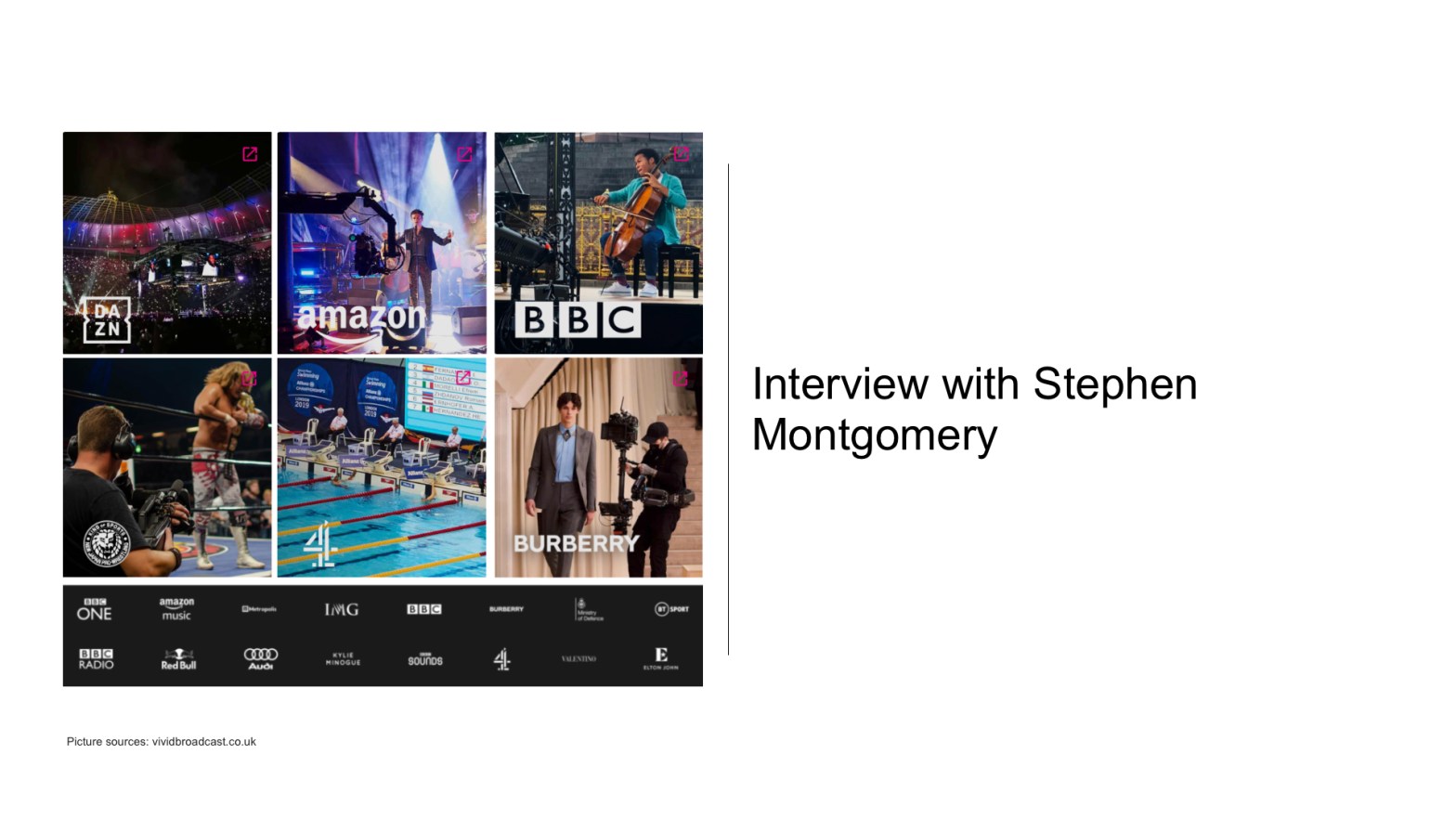
Stephen is Head of Production at Vivid Broadcast. His role is to technically and creatively figure out how to actually make the jobs work. In our time together we discussed the strenghts different media, such as graphics, film and music have and what happens when they come together. We went on to think about media as a communicator in society and the responsibility that comes with that. Are we ever asking what values and messages come across in the music, films or shows we are engaging with?
KAI:
Hi Stephen, it’s great to speak to you today! You are part of the team at Vivid Broadcast. It would be great to hear what you do and what a day at work looks like.
STEPHEN:
I think for us every day is different. That is part of the challenge but also part of the fun. I don’t think I could ever do a job where I was doing the same thing every day. Financially, that is where a company like ours needs to get to because there’s a lot of wasted resources in reinventing what we’re doing every time. When you broadcast a football match you know where the cameras go. You turn up at the stadium, two in the middle, one for each goal… you shoot it and go home. That’s very economical because you can repeat it again and again and again. On other productions you have to come up with new strategies all the time. There is a repetitive nature to what we do, but equally it’s very bespoke.
KAI:
What is your specific role in the company?
STEPHEN:
On paper I’m down as Head of Production. I tend to get involved in anything that’s new. That involves working out how we do things. We might have won a contract to do something, but we’ve got to work out how to actually do it, both technically and creatively. That’s my role.
KAI:
With so many other media companies out there, what makes Vivid stand out? Where is your sort of place do you think?
STEPHEN:
I think we’re sort of a middle ground size. There’s a lot of bigger companies, but that makes them potentially less flexible and nimble. Equally though, we do have a lot of experience and size that enables us to deliver something big. We do try and do a lot of very bespoke projects. A lot of what we do is maybe too complicated for some of those who simply turn up and do the football matches. They’re not set up to be able to work out how to do something different.
KAI:
How did you come to do what you’re doing now?
STEPHEN:
It was kind of by accident. I initially wanted to be a sound engineer. For the year 10 work experience at school I was supposed to go to a recording studio, but my contact left and went to a TV studio. He basically said, “I’ll find someone else at the recording studio to take you on work experience”, but I asked whether I could come with him to his new place. I didn’t want anything to do with television, but when you are 14 years old you don’t mind so much. Obviously, it was the right choice, and I like it in TV now.
But through the COVID period a lot of people I know, who were maybe not working so much because events got cancelled and things, have gone for a walk in the woods and thought, “I should be doing this more often instead of sitting in a wet car park at the back of a football stadium trying to hold a cable in a socket hoping I don’t get electrocuted…” Whether it’s the technical or creative side, there is a lot of pressure on the kind of work we do and a lot of people that I know have been reflecting on that. It’s not that it’s not rewarding, you know, finishing a production is a bit like climbing a mountain. It’s hard work but when you get to the top it’s like “Ah, great. Let’s do it again!” It’s not that it’s not rewarding, but sometimes you are asking, “Was it really worth all that effort, just for people to watch a football being kicked around on a pitch? Or to hear the songs of a concert?” You do find you ask some soul-searching questions.
KAI:
Some of my research is about multimedia. For example, what music can do that picture can’t or what film can do that text can’t. You could even compare what a graphic can deliver in comparison to a five-minute video. Do you have any thoughts on the strengths different media have and what happens when they come together?
STEPHEN:
I think more and more we’re seeing a convergence of media. Whilst what you say is true, it’s also dangerous to say, “Pictures speak louder than words, so we should just use pictures.” At the moment I’m working on a film series with five episodes of about 15 minutes each. In those episodes we are talking to various experts about a particular topic. We’re very aware that any of them could talk for an hour and it would all be good. Yet, we will only have room for them to speak for about 2 minutes. We know that those 15-minute films are going to be more powerful than just letting them talk and talk, but we’re also very aware that if someone is inspired by watching 15 minutes with a couple of minutes of this and that, they are quite likely to want to go and dig deeper. Alongside the film series therefore we may need to make the full interviews available for people to watch on our website or do a podcast series alongside it, which is a more curated but longer version of it. So yes, some things are more powerful, but I think the power is really in the all-encompassing, holistic approach across all media forms.
If you have a look at the BBC Charter and things like it, approximately 10 years ago they started doing what they called 360-degree commissioning. It meant that you couldn’t ever just have a radio programme or a television series. It needed to hit online, radio… and so on. They are a bit better at that on the radio. When you listen to radio they say, “BBC online, on demand, on digital…”, but that’s where it comes from. This concept is not just them trying to flood you, it’s actually that each of these different media forms has their own strengths. None of them are strong enough by themselves. You need all of them to work together to actually communicate a message. In the words of the BBC, “to inform, entertain and educate.”
KAI:
That makes sense, yes. When you talk about the different strengths, what would you say they are? For example, what strengths do music, text or video have individually?
STEPHEN:
Well, purely off the top of my head, music is emotive. You can bring about an emotional response. There are downsides to things as well. Video, for example, can be very inspiring but attention span might become an issue. Whereas when you have something that’s just audio based you can hold people’s attention for longer.
KAI:
I like to think about media as a communicator. I was talking to a composer recently and we were asking whether it is just ‘great art’ that we are producing or whether we are aware that we are actually ‘communicating’. What are the values? What is the message? What are we telling people? Not just how we say something, but the content of it.
STEPHEN:
I think when it comes to music, by itself it’s only ever going to do a certain thing. But when you combine music with images, you start saying something. The reason why I think music is so powerful is that you can take the same 30 second sequence of drama or news footage, or whatever, and put some sad strings under it and then play it again with some happy-go-lucky kind of music and you’ve got a different film. That music has transformed the message that you’re telling in a way that just changing the images or the order of them, the editing, the actors, or anything else wouldn’t have done. It’s almost the one single element that can change the message compared to every other part of what makes up a piece of video or multimedia.
KAI:
Do you think filmmakers or composers are aware that they are communicating content, not simply making great art?
STEPHEN:
Yes, I mean, particularly if you listen to some of the things people like Hans Zimmer say. There is a trailer to a masterclass of his. The bit they used in that is where he is talking about how a sequence of notes is talking, telling a story…
KAI:
… and answering a phrase, yes.
STEPHEN:
Exactly, I think he says, “That’s the question and this the answer.”
KAI:
I’ve been thinking a lot about what values are being communicated in media and art. Do you have any thoughts on that?
STEPHEN:
I don’t think there’s any kind of misrepresentation. If someone wants to communicate something then what we’re asking is, “What are their values?”, not necessarily what values are coming across in the film. Unless you’re looking at, you know, low budget productions, student films or similar, I wouldn’t say there are sloppy film makers who accidentally communicate values that are not what they want to say. People are a very deliberate. They will use certain colours in the costumes because there’s certain values, emotions, and character traits they want to communicate. Everything is very deliberate, planned, and intentional. I don’t think the question is ever really “What is a film telling us?”, I think what we’re asking is, “What is the filmmaker or director telling us?”
KAI:
Do you think that there’s a certain responsibility that comes with that? In one sense anyone could say anything if they have the finances for the production. Is there a place for thinking about what we do and communicate in society?
STEPHEN:
I watched a documentary at the weekend called The Disappearance of My Mother (2019), which is about an Italian supermodel who essentially got a bit disenchanted with everything. She got older and shunned the camera. She didn’t want to be in front of the lens anymore. Her son became a cinematographer though and wanted to make a film about her. In this documentary you can see the argument about her not wanting to be on camera. Yet her son wants to tell the story about how she doesn’t want to be on camera… It is very self- referential. By actually making the documentary you are going against the very thing that you’re trying to say, which he actually was trying to say in the opposite way… In some ways what he did was slightly cruel. So yes, responsibility is a big issue there. Was he being responsible in exposing his mother and going against her wishes? Or was she complicit in the whole thing and making it up? I don’t know.
KAI:
Great food for thought. Thank you, Stephen. It has been great to speak to you!
To find out more about Vivd, head over and visit their website.
 Kai Vollprecht Media