
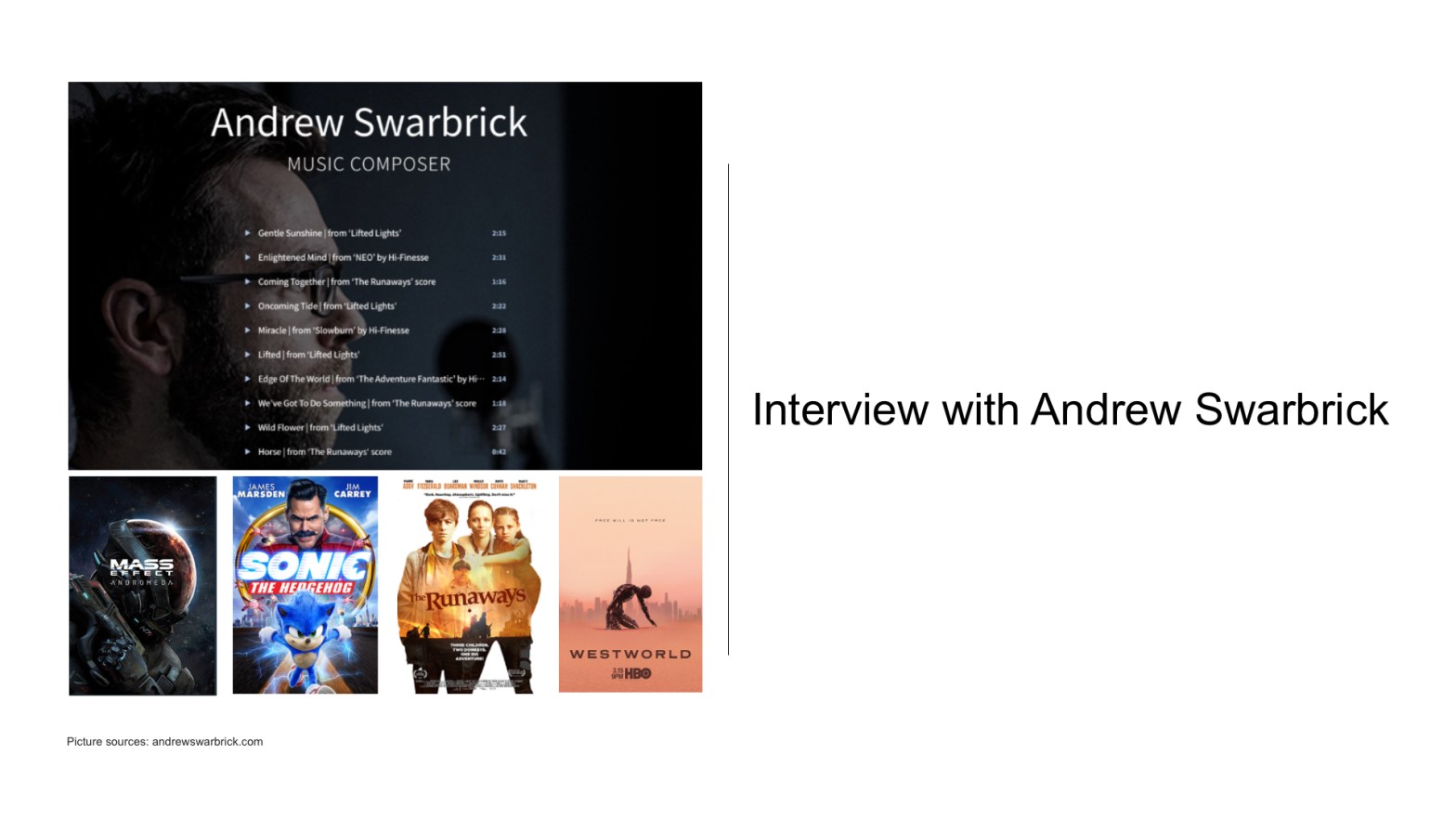
Andrew works in library / trailer music and composes music for film. In our conversation we spoke about how different his creative process is for those two worlds and how he thinks about music’s relationship to picture and story. He also shared about his experience of work & family life and how important it is to look after yourself well by not allowing demands of industry and society to put pressure on you.
KAI:
Hi Andrew, great that you have time to talk today! I thought we could start with one or two personal questions about your journey and why you do what you do and then go on to talk about music relating to other media. So who would you say Andrew Swarbrick is and how would you describe what you do?
ANDREW:
That’s quite a big question. For the last 10 years I have pursued a career in composing music. I have quite a musical background. I played the trumpet in school, sang in a church choir and played in lots of bands. I didn’t know what I wanted to do but my dad always said to stick with things you enjoy doing. My initial thought was to do music at university, but at the time I thought that you either had to be really exceptional or be a teacher. First of all, that makes it sound like I think that teachers are aren’t exceptional but that’s not what I mean. I just didn’t really know what the career paths would be and kind of thought that if you wanted to do anything other than teaching you had to be extremely good on your instrument, for example. I didn’t really have much of an idea of how I could make a career with music. I suppose that’s something that wasn’t really talked about at school or in my development. I chose to do music technology and I didn’t really have any technical background such as studio experience or anything, but I went and did that. In my final year I made friends who were doing film production and we decided to all work together on a film for our first project; I was quite interested in trying to compose music for it. But, with it being a technical degree, I had to do something technical. I couldn’t just compose the music, so I started looking into MIDI orchestration and was quite interested in that.
I started to get very interested in orchestral music at that time. I wouldn’t say ‘classical music’, even though that is obviously part of that, but I was listening to film music and contemporary orchestral music. I was quite fascinated by the orchestra and had the idea of comparing orchestral music created with MIDI versus a live recording. I managed to get a local orchestra involved and was able to twist their arm to record one of my pieces. I then also did a MIDI version and compared both processes – that was my research project. I played a snippet from both and asked people if they could hear differences and what those differences were. It was quite interesting and I enjoyed it. Out of that I just wanted to find a way of making music my job. I decided to do PGCE just before I went to a pitching session in London. By this point I had some pieces that I’d made. It was orchestral music sounded something like The Lord of the Rings (2001-2003). Through the pitching session I got a contact in trailer music. I did do my PGCE in the end, but the introduction to library music and trailer music was a whole world of music licensing which I had no idea about.
I started working with this guy who was basically just pitching music for Hollywood trailers. That was really high quality and my production skills weren’t quite good enough for that. But he kept giving me feedback and helped me. Meanwhile I started working with other publishers. That was lower level and less pressure kind of library music. Around the same time I met a film director who is local to me here in Sheffield. Those two contacts, the trailer music guy and the film director are still contacts that I work with today. They are long-term connections. It’s been a very slow growing thing, but it got to the point when my daughter was born, about five years ago, when I made the jump to not having any other jobs. I’ve just about made it work. It seems to be going in the right direction.
As you probably know, I did one feature film with director Richard Heap. I loved that process! That was completely different to working with library music publishers. You do have briefs when you’re working in library music, because often the publisher likes to release music in quite an orderly fashion; but what I loved about working with the Runaways (2019) was the creative process with the director. I enjoyed actually getting involved with filmmaking and story. It’s just more than doing music for the shelf that gets picked up later for something that you don’t even know. My dream is to do more film. If Richard does more films I am probably quite well positioned to work with him, but I am also trying to get more connections in the film industry. Though I have climbed quite high in the library music world there isn’t necessarily any crossover. The only way that could happen is if a filmmaker was to use my library music and like it so much that they would contact me for original music for his project. Other than that, I think I just need to go and meet people, which means going to film festivals and events like that. It’s tough. I mean my ultimate dream is to do a Pixar movie. I’m a massive fan of Pixar. So yeah, that’s me in terms of work.
KAI:
What inspires you in life? What motivates you to do what you do?
ANDREW:
There’s another very big question. I would say it’s been a huge journey.
There is my faith, which is a big part. And there has always been the question of what God wants me to do with life versus what I want to do and whether that matches up. I never had a clear answer to that question. It takes a lot of personal investment to try and get a career like this off the ground. You’re putting a lot of your own resources, time, energy, headspace, and emotions all into creating music. So as soon as the question “Why am I doing this?”, or “Should I be doing this?” comes up and you don’t know the answer to it, you can really doubt yourself and make it quite tricky for yourself.
One question I would often come down to was “Who am I helping?” I suppose I feel like there’s lots of need in the world and why shouldn’t I be doing something else to help people? When I brought that up and talked to other people about that they would say, “Yes, but arts and music are so important. People need it…” – somehow that would encourage me but it also wasn’t quite enough. I suppose it’s been a journey over time where I’ve become a lot freer in what I’m doing, and I just accept that this is what I love to do. I love to express myself through music.
I love to watch Pixar films with my kids. I love the messages that they have, the emotion and the way that music adds to that. That gets me excited! I don’t fully know where it’s all going. It might be that in 20 years’ time I go back to teaching because I have this overwhelming feeling that I want to sow into people’s lives in that way. But essentially the whole journey has been that I don’t know what it is going to be like in a few months, including finances. Sometimes I know that I have money for the next month, but I don’t know about the month after that. It always works itself out somehow and that area has become easier and easier. It still feels tight though, because obviously the rest of your life grows almost at the same pace.
In the last few years it started to feel more settled and I have slowly started to get more capacity for other areas of life. Doing something like this can really dominate. It becomes so important to you and you are really trying to make it work. Like I said earlier, you are putting all your resources into it, and that can really take it out of you. Also, one of the things about being a composer like this is that you shut yourself in a room on your own, which has another impact on life. Mental health in the composing industry is a huge thing because of that very reason. So yes, you’ve got to graft and pave the way early on, but also look after yourself as well. I think over the last few years I’ve started to be able to do that a bit more and have relaxed more. Obviously I still have these huge things about “Where am I going to get this connection in the film industry or with a director or producer…” But I say to myself that even if I had the choice and someone said to me that I could work on this big title and choose when it happens… I wouldn’t choose for it to happen now anyway. I’ve got two young children and I wouldn’t want everything to kick off in that way right now. If I had the choice, maybe in five years’ time. So, in a way, if you bring God into it, He’s got a plan and I’m just enjoying what I’m doing.
The other night I was chatting to my daughter as I put her to bed. We had watched Encanto (2021) that day. I often say, “What do you want to say thank you for?”, we pray before we go to bed. She said, “You know what, I just really enjoyed watching TV”. I said, “Well, all right, we can thank God for the people who made the film”, and we did. Then I said to her, “You know, I would love to get involved in doing that kind of thing at some point”, and she said, “I know”. Then I said, “Do you think I ever will?” … you can’t make this up, but she then just started singing this song to me. The lyrics were something like “Your dream will come true, but for now just give me a cuddle.” What I took away from that was simply not to worry but just to enjoy being with your family. I think I’ve managed to balance things out a bit more and family helps. I’ve only got three and a half days in the week to work now. I don’t know what I used to do with my time when I had more time. How old are you if you don’t mind me asking?
KAI:
I’m 24 now.
ANDREW:
Yeah, when I was 24 – no wife, no kids – I just had all the time ever! The idea of that to me now is crazy! What did I use to do with that time? Now I’ve got my working week, which is three and a half days, and you just have to focus on getting things done in that time; that’s the time you’ve got. But if you think about it, that’s only half of the week. I’ve got another three and a half days, which is basically family and I think that’s healthy. If you’re trying to make your way into some sort of bit of the industry it can be so soul destroying, so relentless and so rejecting. You send your music out, but no one cares… and you have to deal with all of that.
KAI:
You talked about the difference of making library music versus working on a feature film. In terms of your creative process, how is that different?
ANDREW:
I think with library music the process is that you have to think about what this music is going to be used for and what makes it useful for an editor or someone putting together an advert or a promo. So, with libraries it tends to be quite a formulaic thing, really.
Looking at it in a very simplistic way, you do three sections with a break between each of them to give the editor edit points. Something that makes a good library track is that it has a theme and sticks to it. You don’t want it to meander off in any direction because it then becomes a lot less useful for the end user. They don’t want it to suddenly change mood. They choose the track because they like the mood, so if you change direction, it might not fit with what they are trying to do. You have to think about constructing a track that is going to be useful in a lot of situations. If you can do that then obviously it’s going to get used more. With film it’s completely different – it’s about the film. With The Runaways (2019) it was a conversation with the director to learn about what the film was about and to find out what kind of music the he thought he wanted. You might start working to picture straight away or you might not; you might come up with something like a bespoke library with let’s say thematic ideas, textures, and things like that. They might then edit to your music, and you might change it again to fit the picture later… It’s a process that you go through. In my case the director was able to share with me a 30 minute stretch that he had already edited. He told me that he wanted the music to have “intimacy and space” – quite abstract words. In a way though that is a nice thing because I’ve heard other people trying to work with directors who were attempting to talk in musical terms but weren’t musical at all – that can get very confusing. They might say something they think means something else… Basically, you need to get into the head of the director and find out what he really means. I imagine that’s just a relational thing. If you’re used to working with someone, brilliant. If you work with someone new you have to figure out how they work, how they think and what they mean when they say certain things.
The Runaways (2019) had a folk band in the pub type vibe and so I had ideas along those lines. I put together ten or so ideas initially and the director picked out one bit that he liked. It’s a family drama / adventure and I wanted to come up with a theme for the three children. Then there was an evil uncle character and I wanted to come up with something that would sort of be him. Oh yeah, and there was also a theme for the very sad part of the film too, which comes through at a couple of points. Once you’ve got those in the bag and the director likes them, that’s good. I then got given the scenes and it slowly came together. I would work over here on this scene for a bit, then on another… and I suppose there’s a cohesiveness to it. It’s just completely different to working with library music.
KAI:
It sounds like you enjoyed that process!
ANDREW:
Yes, and I guess it’s also something original. With library music you don’t know what the music is going to be used for necessarily. With film you know, “I’m writing for this child” or “for this uncle” or “this sad point in the story” … and you have that connection to it.
I think one thing that helps when you’re composing is to think about how humans respond. I find that if it feels true to you and you truly connect with it, it is likely that other people will as well. But it’s also relative. What’s ‘sad’ in one film might not be so sad in another. What might sound ‘dangerous’ in one film doesn’t necessarily sound dangerous in another. If the whole film has been quite light and you suddenly come in with a low peddled note… that will really affect people and they will wonder what is going on because it’s so uneasy. But if it’s a Marvel film where you just have a wall of everything… that one note isn’t really going to have much of an impact, is it?
I think there is a relativity to it, but there are idioms. Think of a whole tone scale. People refer to that and say, “Oh, it sounds dreamy”, everyone has that association with it. Those associations must have come from somewhere, they must be there for a reason.
KAI:
You are talking about film, music, and emotion. It’s a slightly broad question, but what do you think music can do that picture can’t… or film can that music or text can’t…? They are all different expressions, aren’t they? For example, if I watch a film without music or sound, I feel as though I am at a distance to it. It is more difficult for me to engage with it. As soon as music is there, I’m right there. Music seems to immerse people in a way that film by itself can’t. But then, for some people, if they just listen to music without picture, they would switch off because their attention span may be so short…
Do you have any thoughts on that?
ANDREW:
Well, I suppose in a film there may be a character and music can help the audience understand what might be happening inside of him or her – the things you can’t see such as emotion or what’s on their mind. They might be looking at something, but without the music you wouldn’t know what they were thinking. The music might dissappear and you are wondering if something is about to happen. Music can help the audience in that way.
One interesting thing that happened in The Runaways (2019) was a scene that I thought was quite funny. In the story three children escape across the countryside. The younger sibling, around eight years old, suddenly says, “I need a poo” and the older one replies, “Well, just find a big leaf” … and I thought that was quite funny. Initially the music I did was taking the theme of the children, using in quite a light way. When I showed it to the director he was like “No, no, no, no… this needs to be laughter in the dark.” What I didn’t appreciate was what was going to happen just after this moment. The scope of the film was on its way down and he explained that the mood was heading to a particular place. He didn’t want it to be light or funny at all. That’s what music can do; it can help the pacing and direction of a film – taking the audience on a journey.
If you put different music to different things, and it can completely change your experience of it. As a composer you have a lot of control, but I think a truly good film doesn’t have to rely on music. I hear a lot that directors want the music to save their film. “The scene isn’t working, so hopefully the music will fix it…”, maybe sometimes it can… but if that’s the case, the film isn’t good enough. I hear that over and over again.
I suppose what you want to aim for with the score, in terms of the ‘right moment’ for something, when you want the audience to really feel the depth of the situation for example, is setting them up beforehand. You can’t just play a touching piece of music and expect it to help the story. At the beginning of How to Train Your Dragon (2010) everyone hears a motif. At the time you don’t think about it much but then you hear it again later on in a sort of detached way. At one point in the film there is a moment between the dragon and the kid and you suddenly hear the motif in full. Because you heard it beforehand it’s even more emotional and you feel more connected to it. So, you can use music in that way as well. Like I said earlier on, I think music can help you get inside a character’s head. With film you can’t do that very easily. Theatre is way more obvious. Much bigger movements! Film is so subtle. The slightest movements or sounds can mean anything. In theatre you can’t expect the audience to see every detail.
KAI:
One of the things I am very interested in is to think of music, film, and other media as ‘communicators’. They bring a message that has some sort of impact on an audience.
ANDREW:
I don’t know if you have seen Encanto (2021) but the whole message of that film is beautiful and worth saying and the music really helps to get that message across.
KAI:
One of the things I’ve been wondering about is what kind of values we are sometimes being communicated in society, whether it’s about violence, romance, family life… In one way, by giving certain messages such a big stage (e.g., through cinema or other media) … are we saying something about our values as a society, at least unconsciously? I think as film makers and composer we’re not just making great art but we’re also saying something with it. I’m just wondering whether we are aware of that and whether we are intentional with it? You can really immerse people in an emotion or a story, especially with children and young people – that’s powerful.
ANDREW:
I suppose that’s very interesting with library music. With a film score you know what you’re doing it for, whereas with library music you don’t. One of my tracks was used on a Donald Trump video. It was a trailer track, really. They used it for his return from having survived COVID to try and tell people that he was a sort of hero who had survived triumphantly. A lot of those emotions might have been intended to come across when I made the track, but it was used for a particular message. I didn’t have any control over that.
KAI:
Thank you, Andrew. It was great to speak to you. I have been thinking about values and communication alot. Thank you also for sharing about your creative process and how work and family life go together for you.
To listen to Andrew’s music and find his latest work, head over to his website.



 Kai Vollprecht Media