
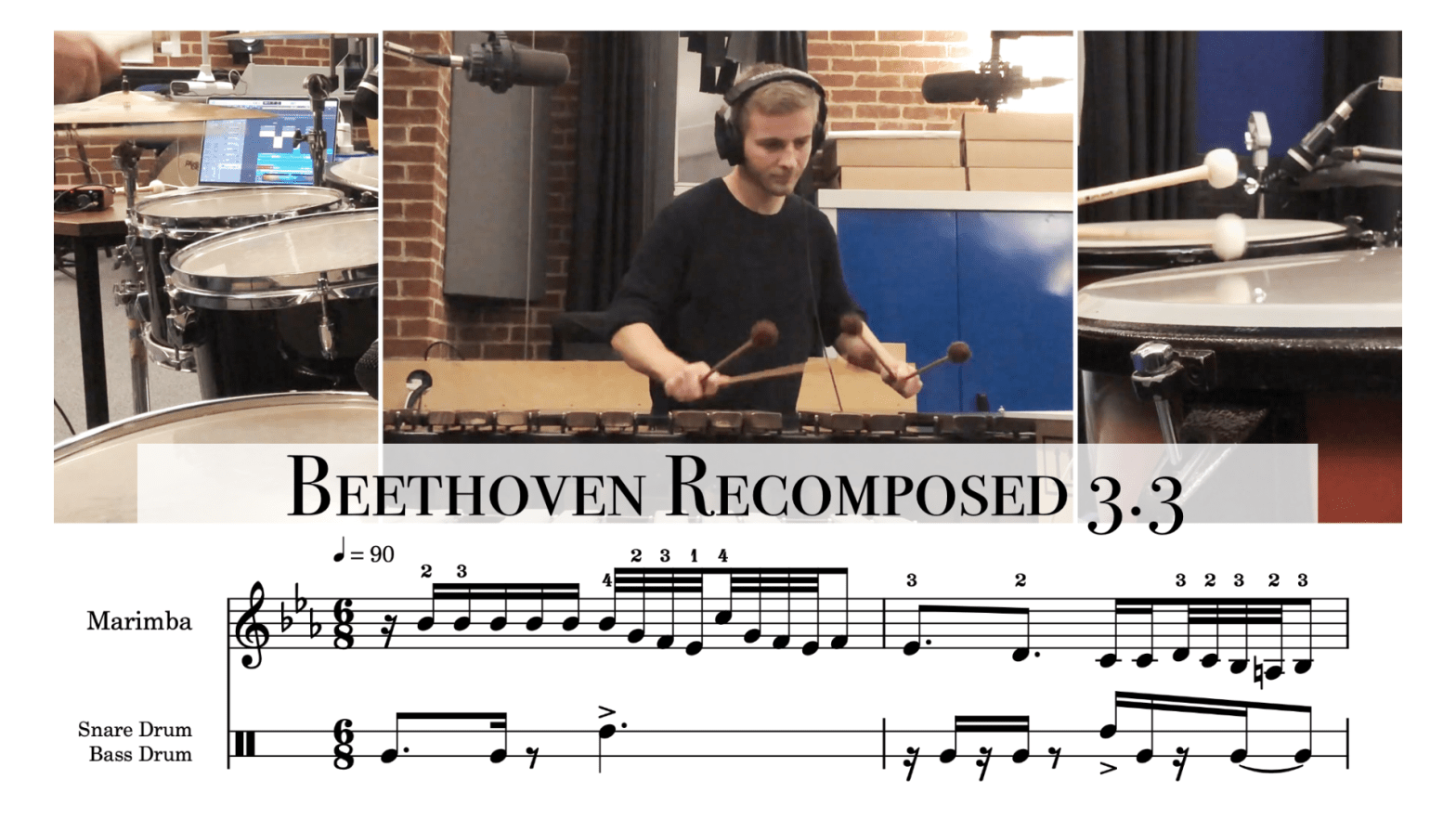
Beethoven Recomposed 3.3 is a percussion take on third movement of Ludwig van Beethoven’s third symphony – the Eroica Symphony. From orchestra to percussion sextet, harmonic and melodic elements from the original have inspired this new work while the rhythmic character has been reimagined.
The Recomposition Process
Listening to the opening of Beethoven’s Scherzo: Allegro vivace, the third movement of the symphony, what stood out to me was the texture he creates with the string section. To start with he uses tremolo crotchets alternating between two notes. He follows this with a sudden upward movement and surprises the listener with the entry of a melody that for the first time seems to establish a sense of orientation for the audience. I wanted to explore these aspects of texture, rhythm and surprise in my recomposition of the piece.
In an article on recompositions by Schoenberg, Stravinsky and Webern, Joseph N. Straus observes in a particular case study that…
“The presence of the new … layer … forces us to rehear the original layer in a new way.”
Straus, J. N. (1986) Recompositions by Schoenberg, Stravinsky, and Webern
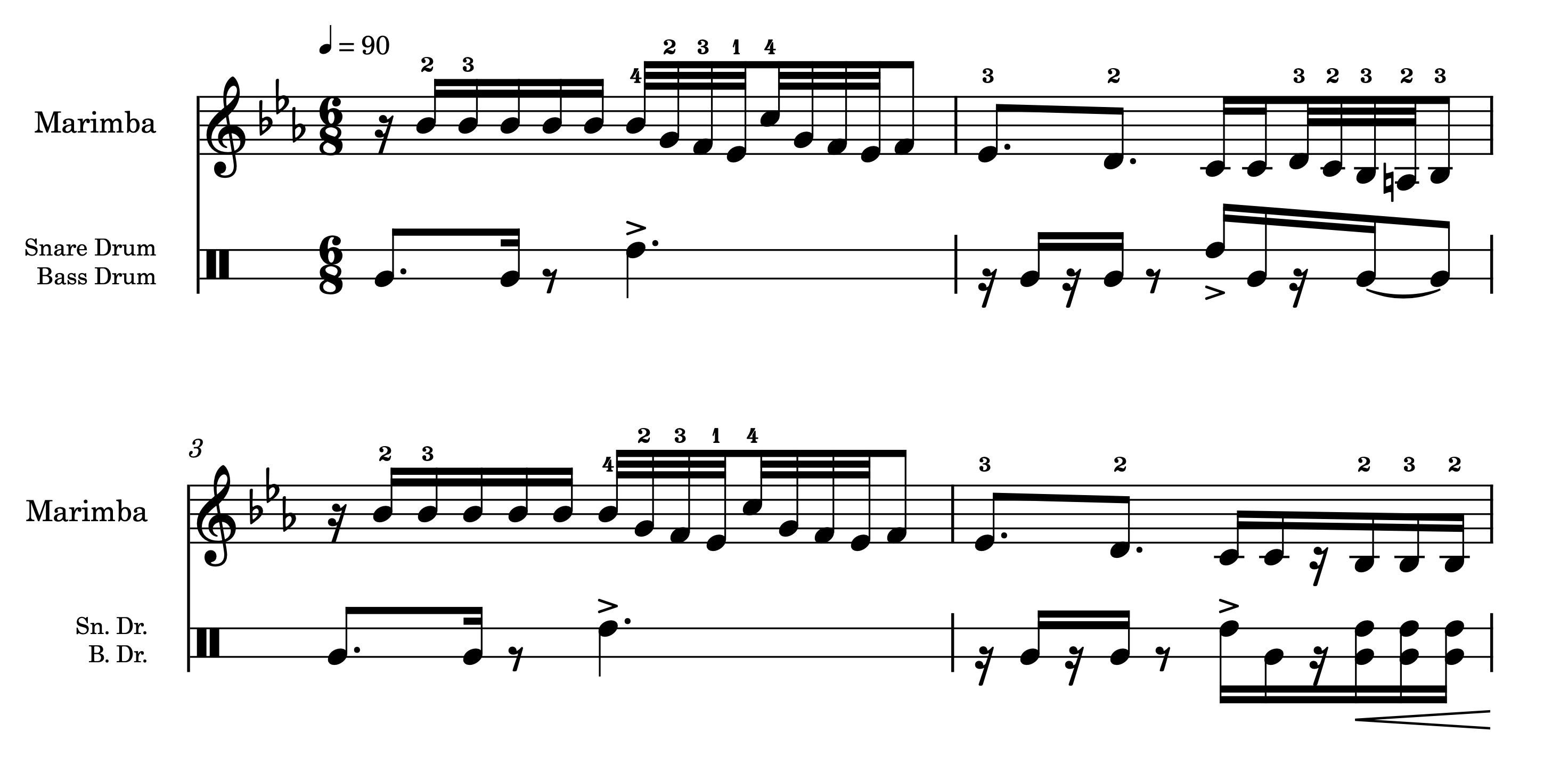
My primary inspiration with this project was to try to preserve Beethoven’s characteristic first theme in a way that would be recognisable but reshape its musical context and rhythmic foundation. Instead of the original key signature of 3 / 4 with an emphasis on the first beat, I wanted to pull the melodic line into 6 / 8, moving the emphasis mainly to beat 4.
The score example below shows the change of rhythmic foundation in Bass Drum and Snare Drum with the adaptation of the theme played by the Marimba (and later doubled by the Vibraphone). Listen to the original for a 5-6 seconds (Hypertext link opens a new window), then lean in to the percussion recomposition. Can you hear the difference?
Other aspects of the Scherzo that I worked with were the call & response in the trio and a short three-note movement in the coda.
In the trio Beethoven’s creates a call & response moment among the orchestra, which I translated to Marimba in conversation with Vibraphone and Bass Drum / Snare Drum. You can compare the two again by listening to the original and then jumping to my recomposition. Can you identify the similarities and differences?
In the coda I discovered a gentle three note chromatic upward movement in the woodwinds. I you listen for about 4-5 seconds, you can hear it here. In my recomposition I wanted to extract and focus on this short musical snippet and designed the entire ending of the piece with it. It may be rhymically reshaped and played on different instruments, but can you hear the three note upward moving motiv? Here is the recomposed version of it.
Miriam Sheer observed that…
“Beethoven’s general tendency in fast movements was to end his dynamic high points with a sudden fall to a low level.”
Sheer, M. (1992) Patterns of Dynamic Organization in Beethoven’s Eroica Symphony
… and so does my recomposition. It holds on to recognisable elements of the original, but takes other aspects to new places.
How is a ‘recomposition’ different to an ‘arrangement’?
An arrangement intends to stay true to the original as close as possible, but for example instead of being for orchestra, it might be arranged for string quartet, saxophone quintet or percussion ensenmble instead – a different set of instruments. The challenge for the one arranging is to preserve the key musical feautures, such as melodic themes, harmonic textures or rhyhtmic gestures of the original. One of the challenges in this can be to identify which musical aspects matter most and which ones can be left out.
Some examples of Beethoven arrangements for percussion include the Moonlight Sonata for percussion quartet by Matthew Elste and Pathétique, a Sonata originally composed for piano, arranged by Alan Miller for an ensemble of eight players.
In contrast to the arrangement, a recomposition is a practical reworking of an original. Here aspects need to be recognisble and relateble but equally, a new composer takes the existing pieces to new places and transforms it. Often a recomposition makes the listener hear the original in a new way.
With Beethoven Recomposed 3.3 I wanted to take to the third movement of the Eroica to greater extremes and shine a spotlight on aspects that could be overheard otherwise. As I showed above, I explored this in terms of texture and dynamics as well as change of rhythmic emphasis and foundation. By doing so I discovered the great versatility of the original composition and sought to highlight certain qualities to listeners by reworking them or their context.
Bibliography
Sheer, M. (1992) ‘Patterns of Dynamic Organization in Beethoven’s Eroica Symphony’, The Journal of Musicology, 10(4), p. 483-4; 485. Available at: https://www.jstor.org/stable/763646
Straus, J. N. (1986) ‘Recompositions by Schoenberg, Stravinsky, and Webern’, The Musical Quarterly, 72(3), p. 313. Available at: https://www.jstor.org/stable/948144
Jamison Sanchez (2017) Beethoven: Symphony no. 3 in E flat major “Eroica”, op. 55. Available at: https://youtu.be/dTbesxdLwo8 (Accessed 9 August 2023).
 Kai Vollprecht Media