
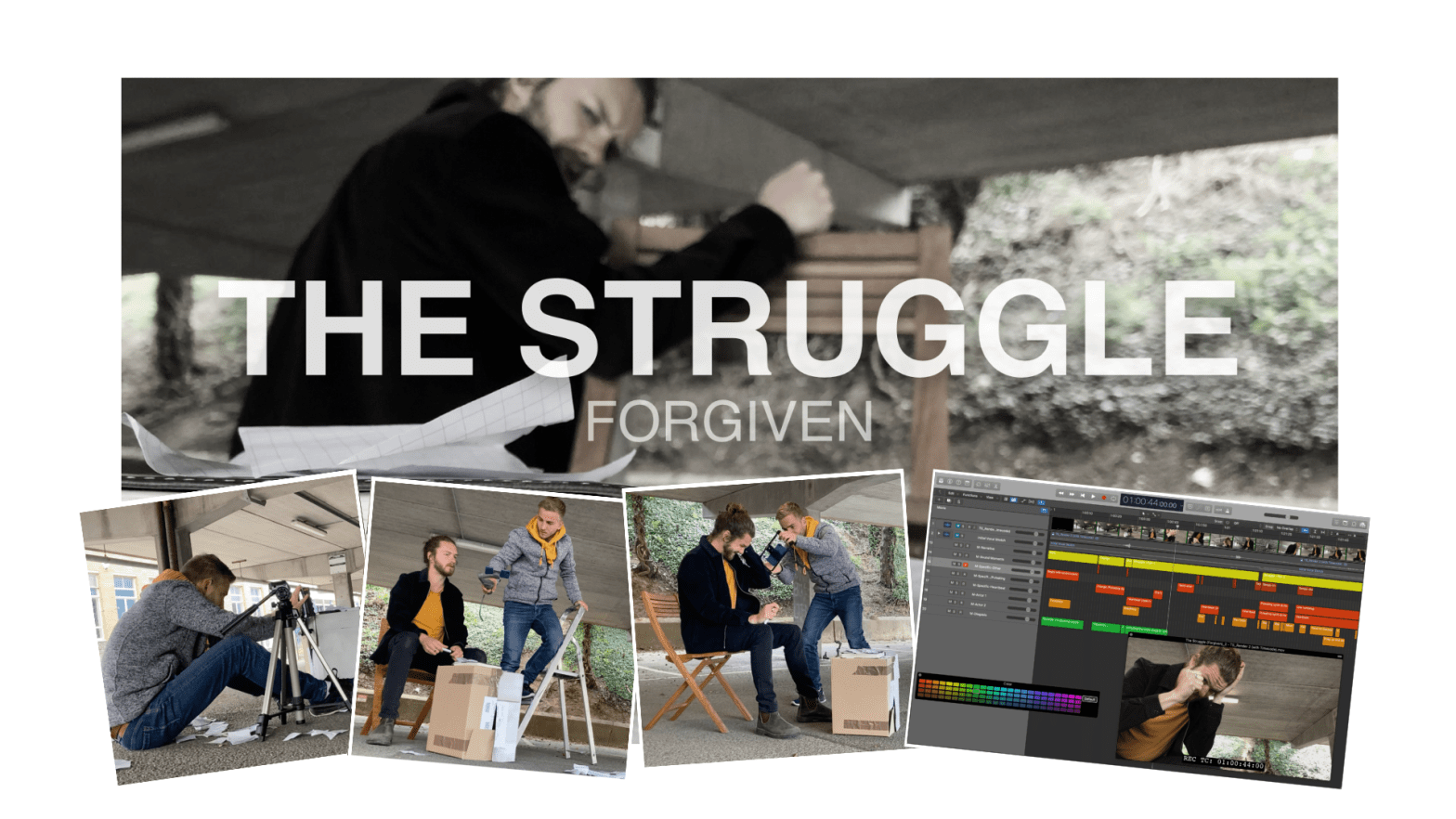
The Struggle (Forgiven) was a project as part of my degree course at the University of Sussex. The aim had been to explore the narrative qualities of sound design.
Viewers are encouraged to immerse themselves in the story and make their own meaningful connections with it. Without any spoken word the powers of gestures and other bodily movements and responses are amplified. Without any music the qualities and human associations with specific sounds gain more attention.
For best viewing & listening experience, play with headphones or stereo speakers in a quiet environment.
Behind The Scenes
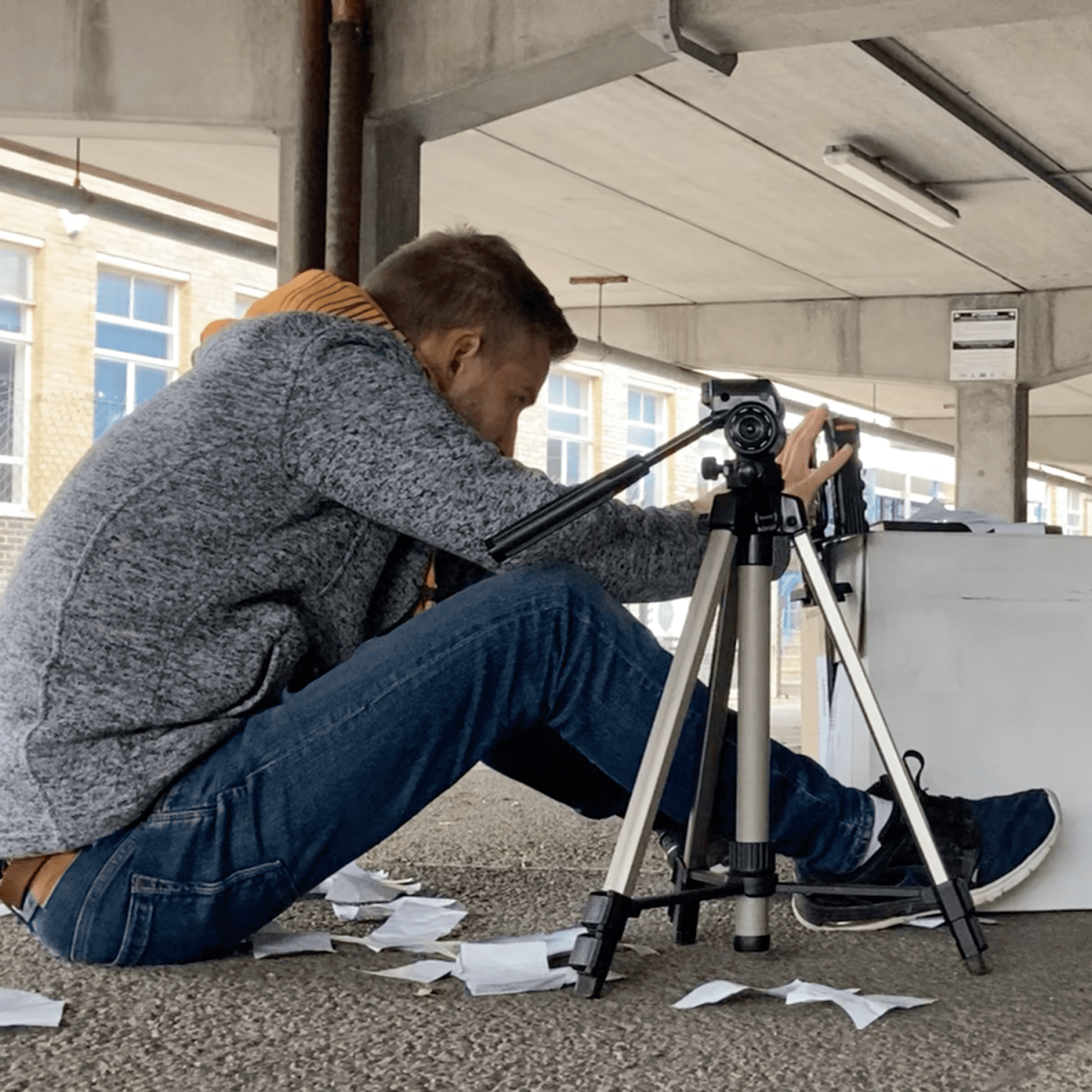
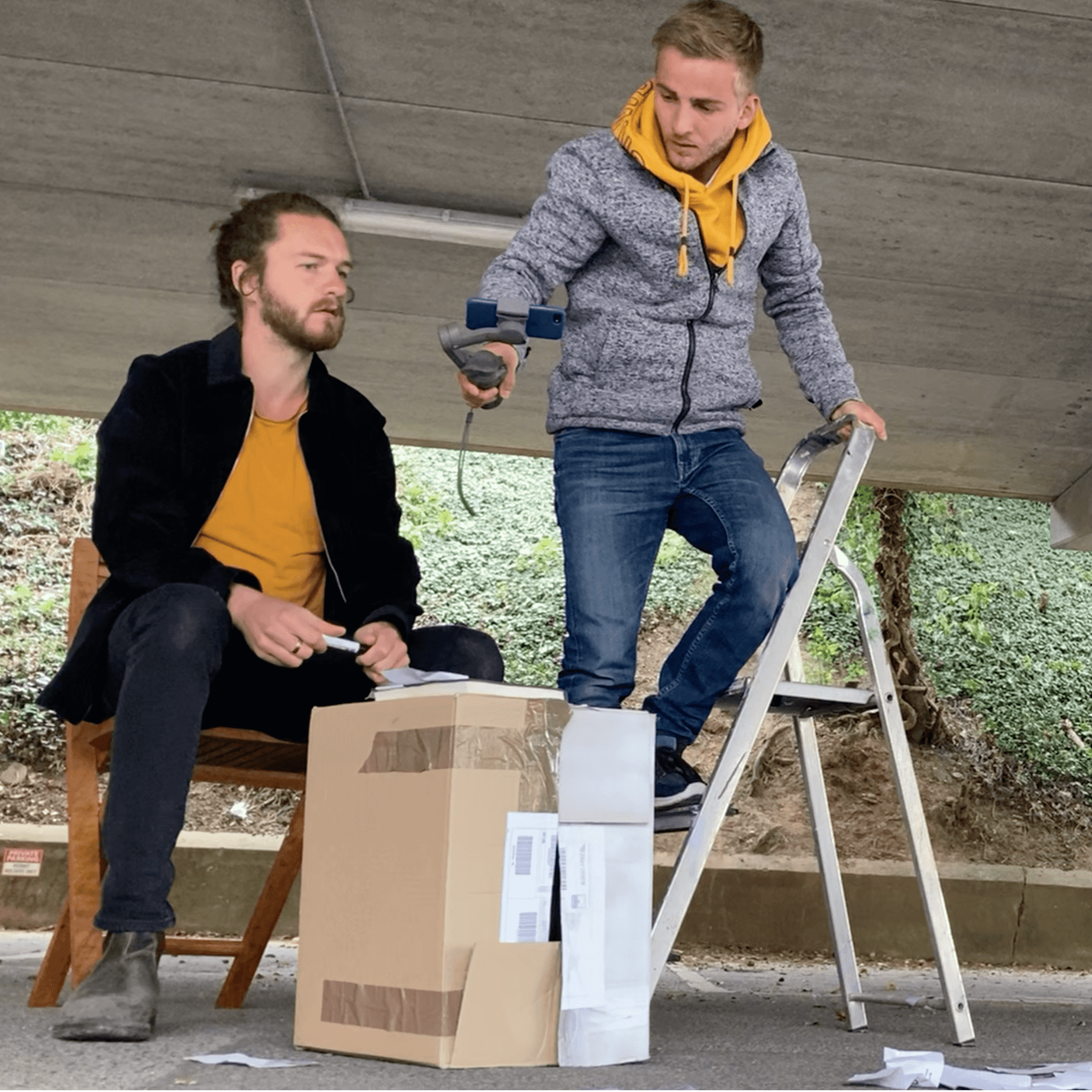
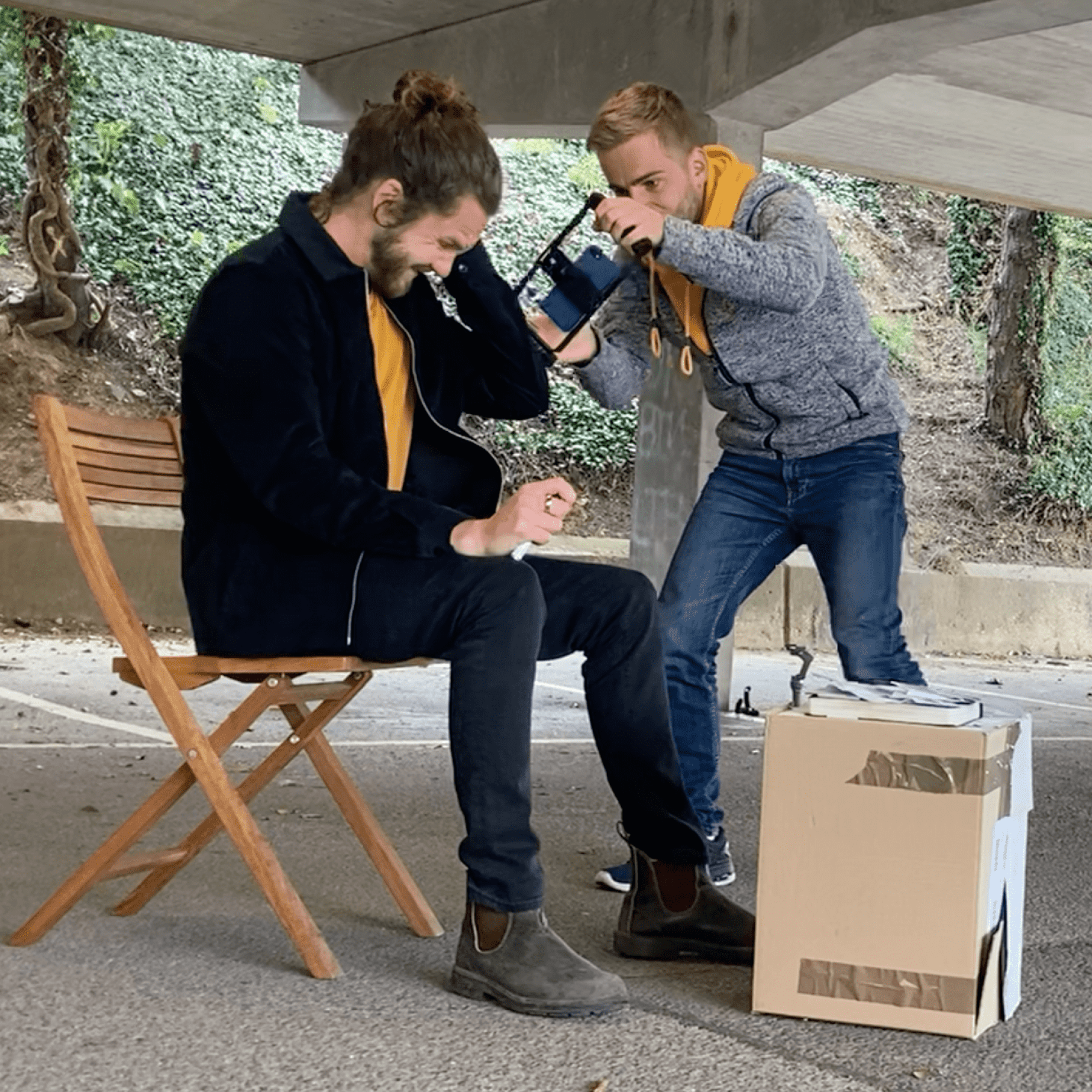
If you want to shoot in a parking garage you have to pick the right time of day… but gladly, we only had a few cars wanting to get past! In the following I want to provide some interest into the creative process for this short film. Those inights, I hope, will give you ideas for expressing creatively what is in you. You might not be trained in a certain field, but simply have a go and explore!
While the task was focused on sound design, conceiving both sound and visuals helped me to think more in detail about how both relate to one another. Already in the conception of the story, I tried to think about how certain moments and developments would be expressed sonically and visually.
Already from the start of the project, I wanted the story not only to be told visually with sonic accompaniment, but my intention was to use sound design as a key component for conveying the narrative. The importance of visual and sonic elements in this project was amplified by the fact that no dialogue was used. How could one get across what is happening on the inside of the actor through the use of sound? How could one sonically present the intensity of a struggle to the point of explosion and follow this with a deep sense of peace and resolution at the end?
“Sound effects are understood as customarily providing ambience, mood, scope and size, but not information, characterisation and plot development, something traditionally understood as the domain of film dialogue.”
Sergi, G. (2006) In Defence of Vulgarity: The Place of Sound Effects in the Cinema
Speaking of theatre, another artistic expression that might be associated with its visual representation before sound might be considered, Ross Brown writes:
“Consideration of the soundscape is becoming a key dramaturgy of postmodern theatre and the design and craft of theatre sound a significant feature of its techne.”
Brown, R. (2005) The Theatre Soundscape and the End of Noise
While there is so much to explore academically about the importance of sound relating to the visual, let’s dive into the creative process of The Struggle (Forgiven). I don’t know about you, but some things you just have to explore while actually ‘making’ art.
Everythings starts somewhere. For me, often, that is a spark, or an idea, that I simply can’t get away from until I choose to develop it in some way. Here, this looked like scribbling on paper, adding different coloured notes and drawing sketches.
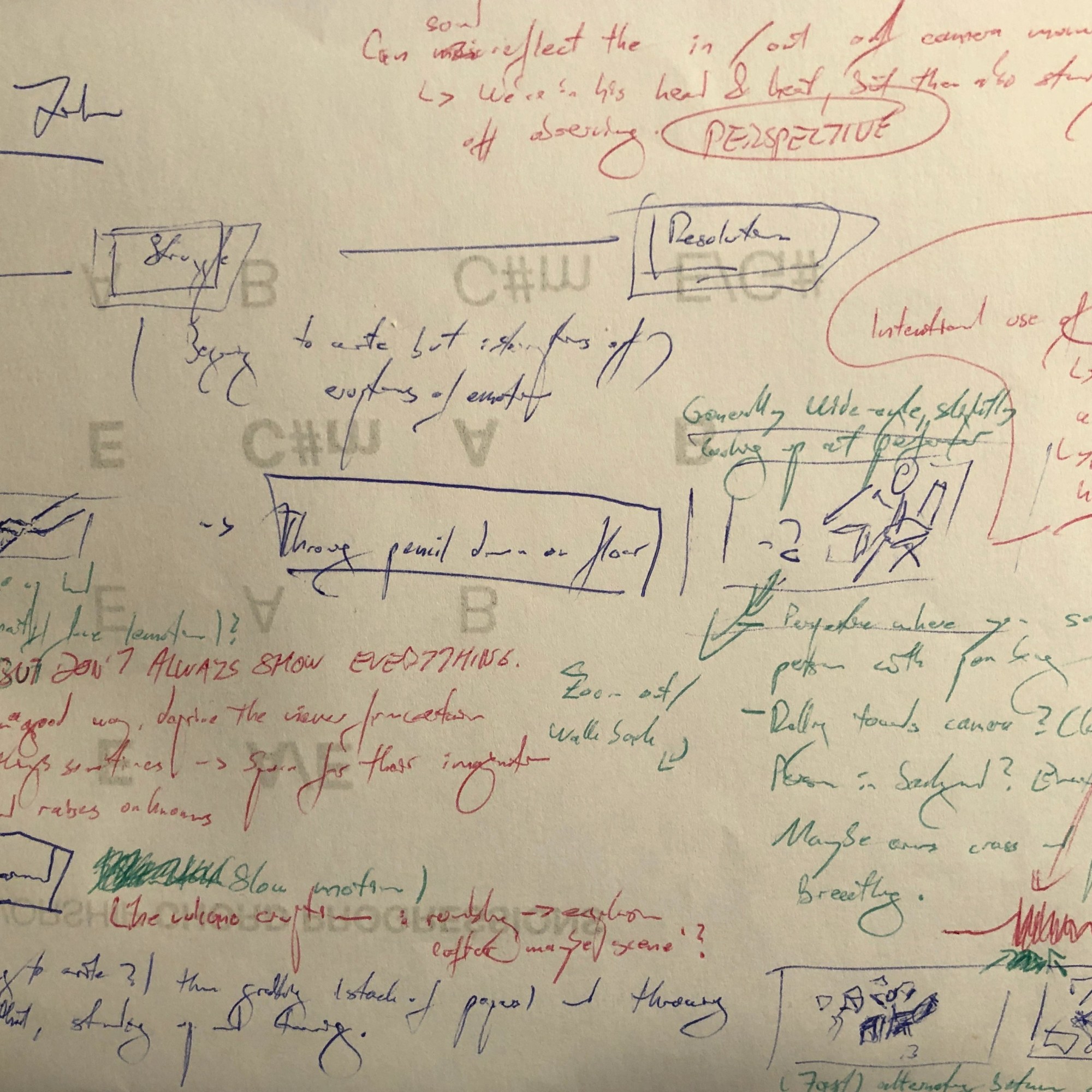
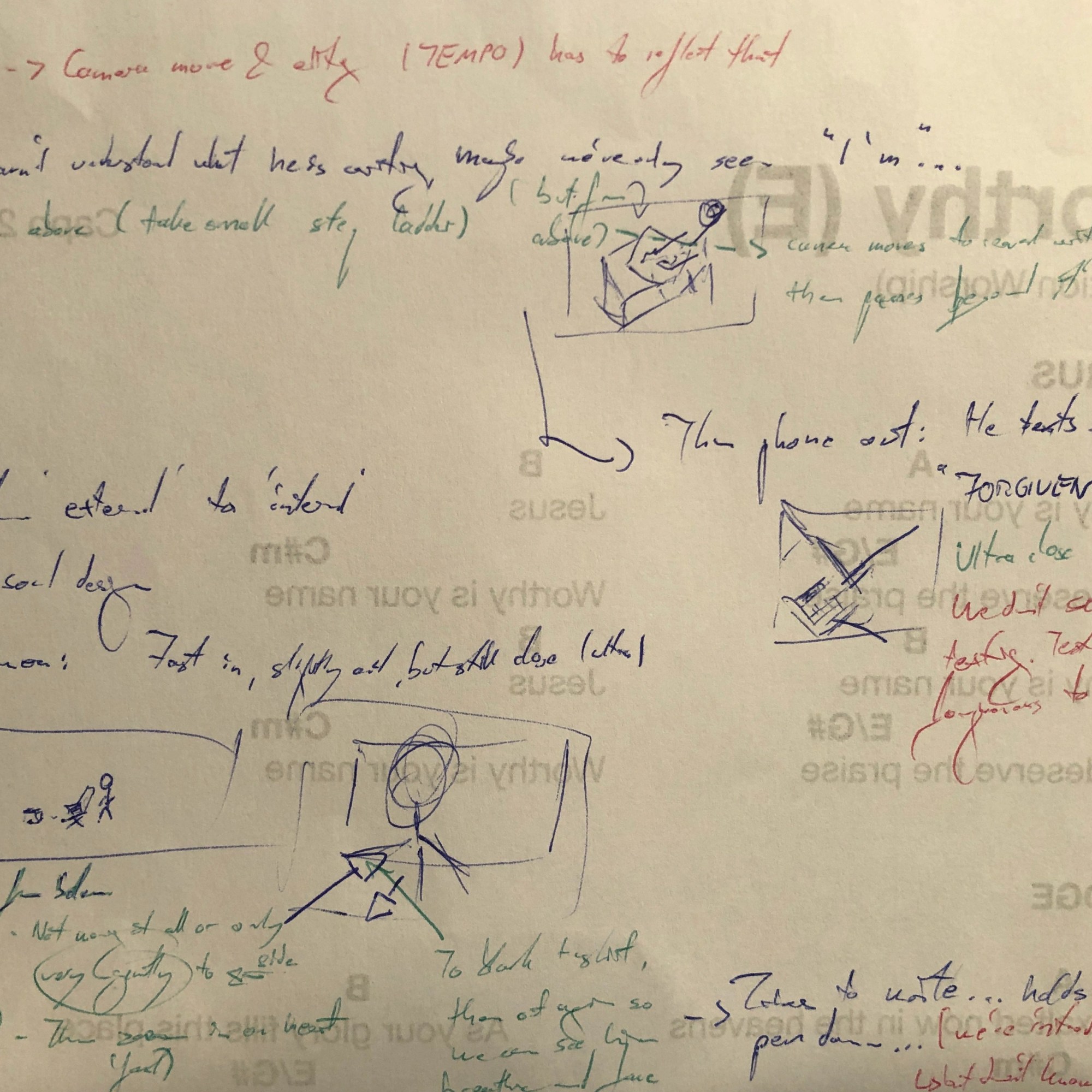
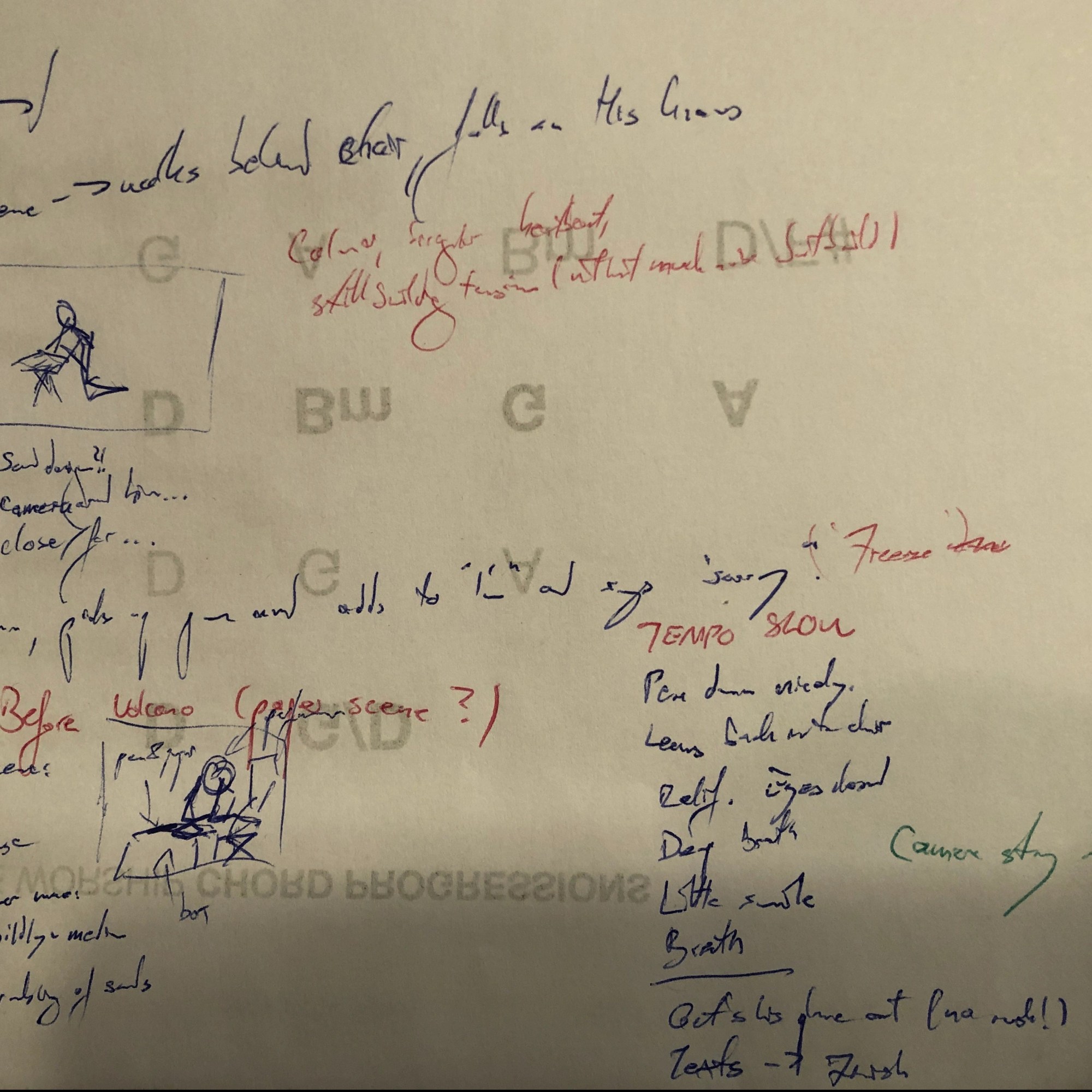
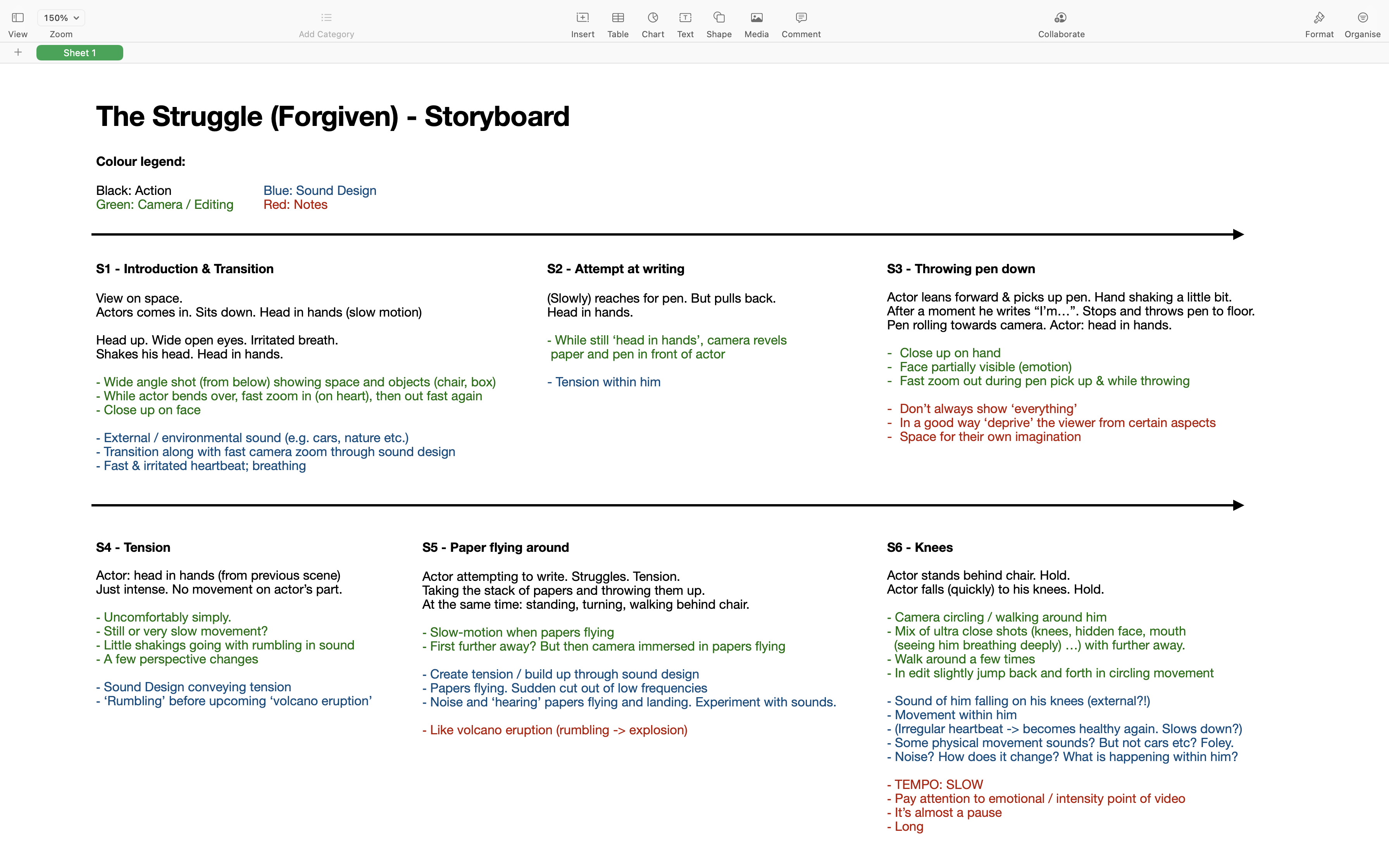
The initial brainstorming was then developed into a more overseeable and actually readable version. The different coloured notes encompass thoughts on action (black), camera / editing (green), sound design (blue) and other notes (red).
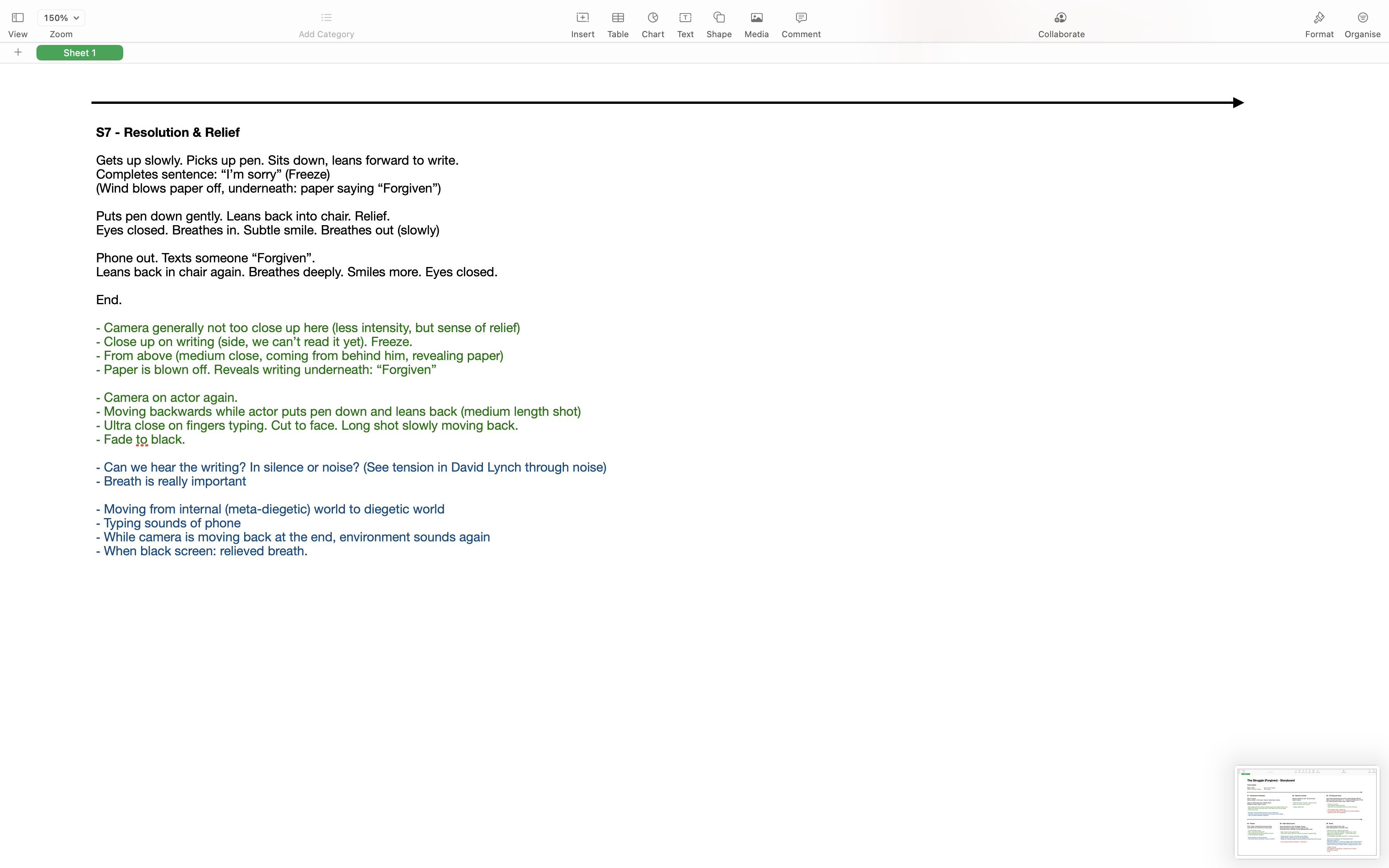
After the filming and editing process, I wanted to approach the sound design with both a ‘macro’ and a ‘micro’ view; seeing the development of the film as a whole as well as digging into the details of it.
One task then was to map out the narrative, the other to identify key moments which would be relevant to the sound design, such as important scene changes, build ups or foley (e.g., sounds of the actor) that would need to be recorded for certain points. From my musical background I looked at this part of the process as creating the sound score, so to speak.
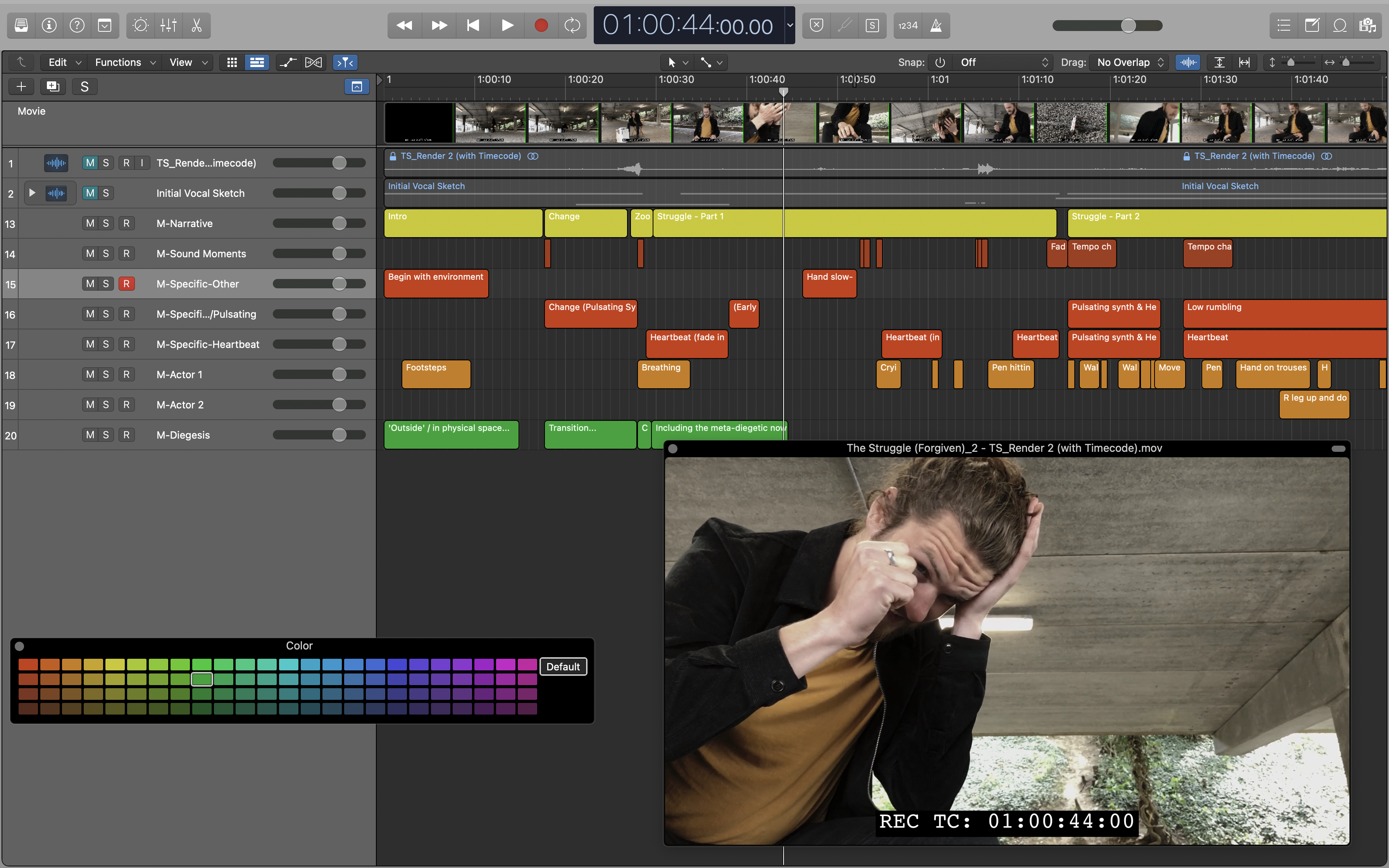
When it came to making the sound design for it, I tried to capture what came most naturally for me. I tried not to put myself ‘in a box’ but capture intuition. In an article on Embodied Sound Design (2018), the authors think about how, apart from Foley, contemporary sound design often happens in a “disembodied way”, because practitioners spend time working with technological equipment and software. They draw attention to the basic channels of human expression.
“… voice and gesture are our natural sound sketching instruments.”
Monache, Rocchesso, Bevilacque, Lemaitre, Baldan, Cera (2018), Embodied Sound Design
In the article they encourage “vocal sketching” as a useful technique in the early stages of the creative process. Below are my own attempts with ideas for sounds resembling wind or volcano eruptions, among others.
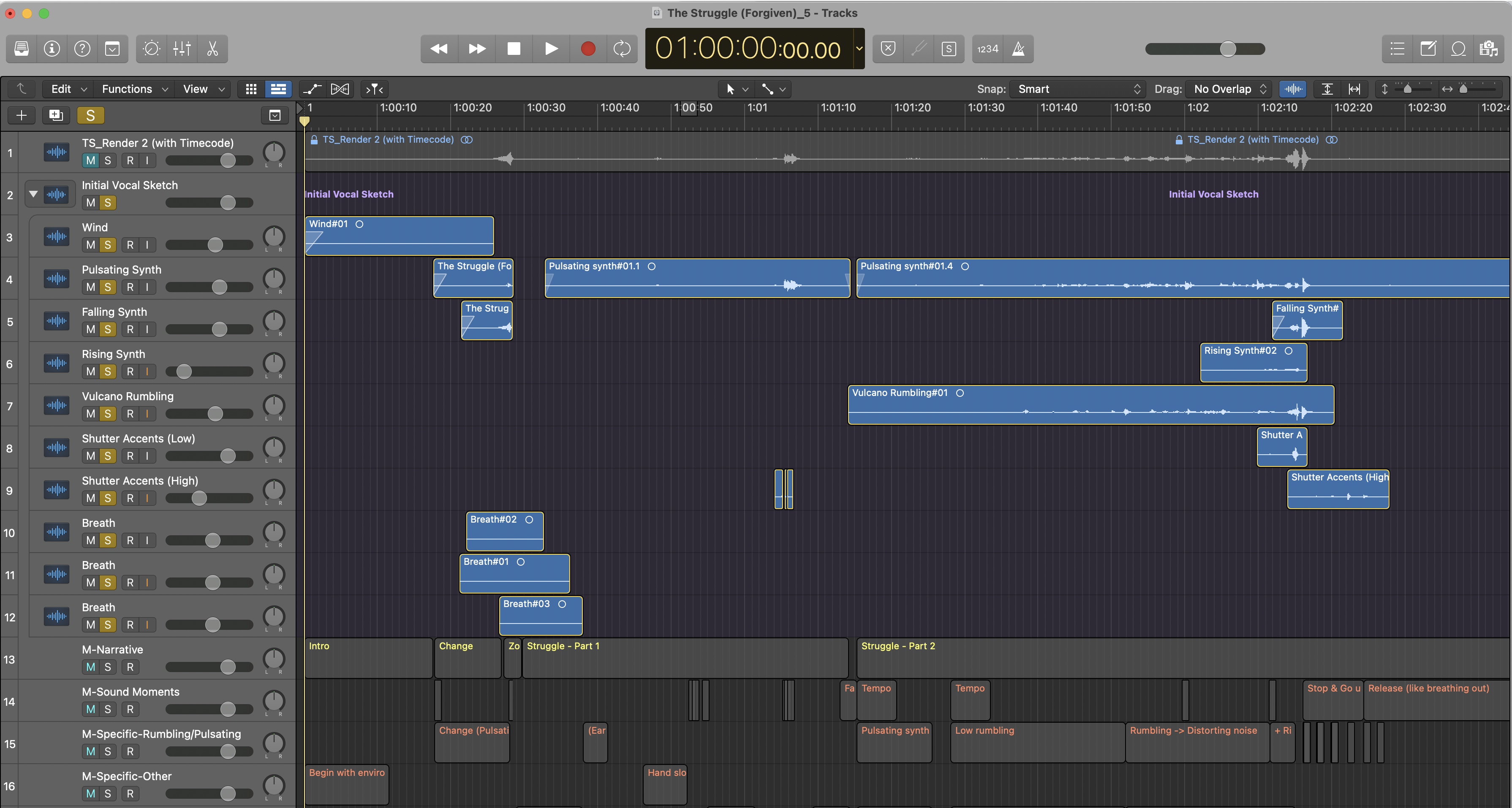
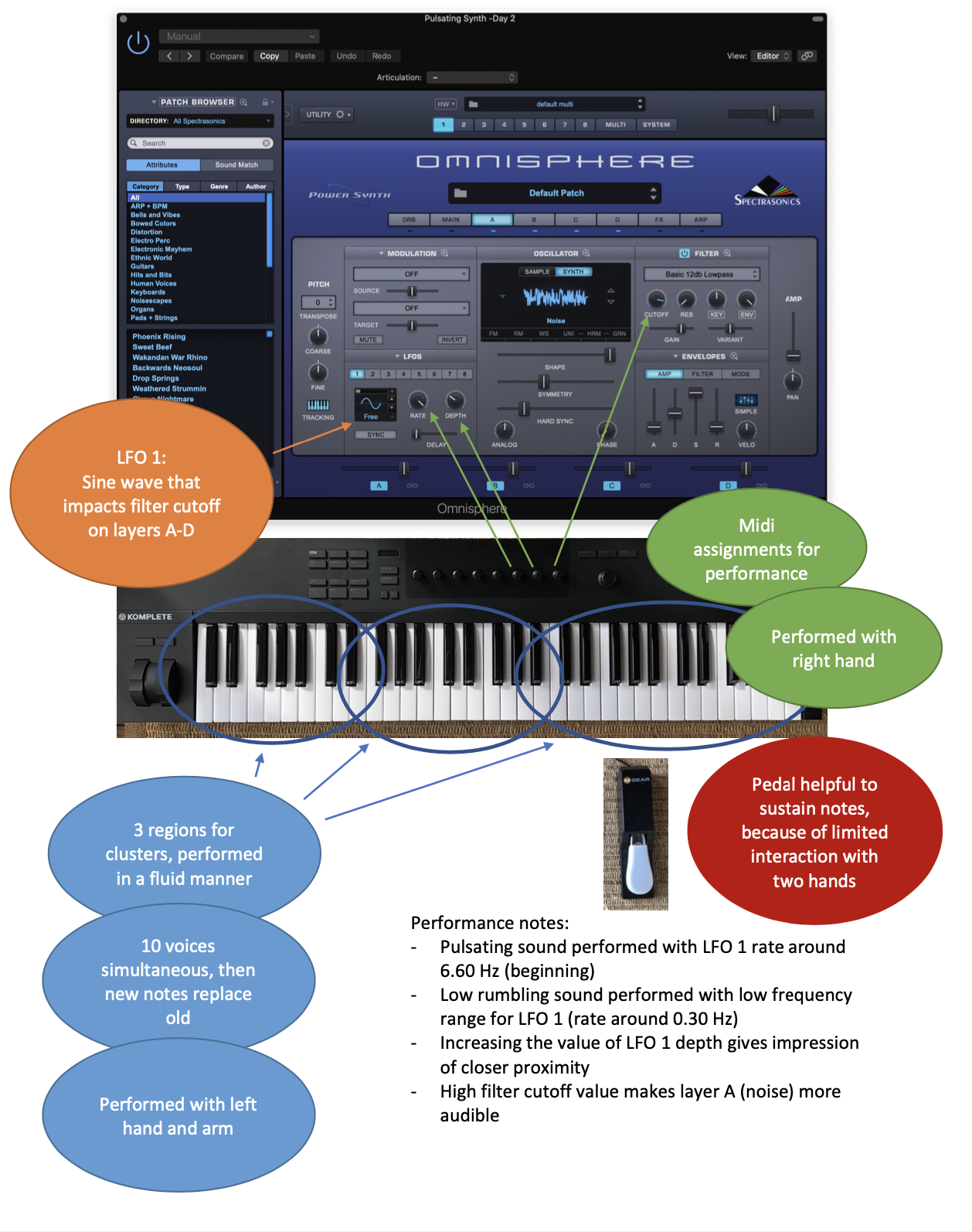
Some of the sketches were then replaced with either the actual recording of sounds or created with the use of digital synthesisers. With my background of performing music I didn’t want to use pre-existing pieces of audio but set up my keyboard for sound performance.
The graphic below shows the Omnisphere 2 patch and how the different knobs and sections of keys of the midi controller were assigned.
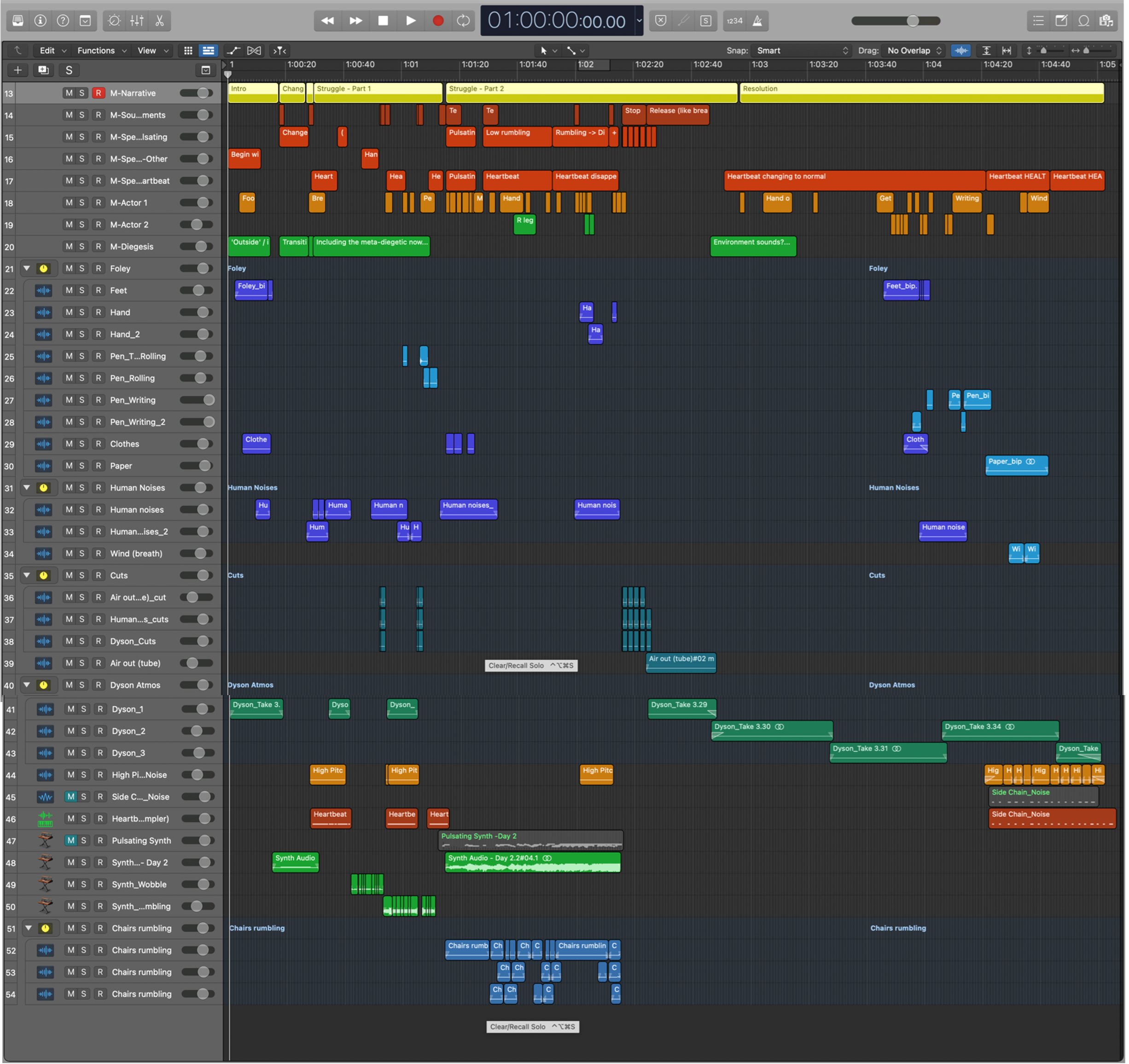
The picture below is an overview of the placings of sound in different groups. Some of the other recorded sounds consisted of a Dyson Purifyer to create atmosphere, chairs rapidly moved on a wooden floor and air coming out of inner tubes of a bicyle. Surely, sound artists always have their eyes and ears open for interesting sounds.
All in all this project allowed exploration of screen writing, filmmaking, sound design, as well as learning to keep the overview as a director. Being able to step back, as well as focusing on details while wanting to communcate a message.
It is the hope and intention of the short film for viewers to relate to the struggle the character is experiencing, but also to consider where he finds his resolution and peace towards the end. Without words, but with emotion and association, visuals and sound can still communicate powerfully and effectively.
Bibliography
- Brown, R. (2005) ‘The Theatre Soundscape and the End of Noise’, Performance Research, 10(4), p. 105, doi: 10.1080/13528165.2005.10871455.
- Monache, S. D., Rocchesso, D., Frederic, B., Guillaume, L., Baldan, S., Cera, A. (2018) ‘Embodied sound design’, International Journal of Human-Computer Studies, 118, p. 48+50, doi: 10.1016/j.ijhcs.2018.05.007.
- Sergi, G. (2006) In Defence of Vulgarity: The Place of Sound Effects in the Cinema. Available at: https://www.nottingham.ac.uk/scope/documents/2006/june-2006/sergi.pdf (Accessed 18 May 2021), p. 5.
 Kai Vollprecht Media